
Pearl Anderson : Right, what we talking about?
Kate Genever : One second. Er, I’m at Pearl Anderson’s house on the 13th of April 2025 for recording her for the Scene But Not Heard project. What, so Pearl, I am, We’re recording around thinking about the drag and gay scene of Hessle Road. So things to do with Vauxhall, things to do with like La Cagelles, all of Ray, all of those people that you know. Erm. But what I’d really like to do is do a bit before that, which is about who you are. So, can you tell us something about you, something about your connection to Hessle Road? Just talk to me who you are. Right. As if you’ve never told me before.
PA: I’m nearly 78, 78 this month. I’ve lived down Liverpool Street until I was 17. I’ve always lived on Hessle Road and I don’t want to move off it. I always say, “Look, take me out of this flat in a wooden box.” Erm, I love Hessle Road and a love the people on Hessle Road. I had a gay cousin and when I was 14, I was told, he had a split personality. And that’s why they put him away. And it wasn’t. They put him away, cause he was gay.
KG : Where did they put him?
PA : They put him into a bad boys home.
KG : Which was where? Was it in Hull somewhere?
PA : No, outside, Outside Hull somewhere, yeah. I was only about 12 or 13 when I found out about it. Because I was trying to work it out, he had a split personality and I didn’t know what one was, I couldn’t work out what one was. And it wasn’t. And it was when I was married and I hadn’t seen him and he said, “Oh, I’m gay.” And I said, “Oh right.” I had no idea what gay meant besides being happy. And he explained to me, sat in dole [laughs] what it meant. And he said, “I’ve come to sign on because I’m gonna jail.” Because you went to jail for being gay then. That was in 1963, ’64.
KG : And had he done something or what had happened or something?
PA : Yeah, he’d been caught in toilets with another man.
KG : Another man?
PA : I won’t say his name, I’ll just tell you it was a solicitor. And Christopher took all the blame. So nothing happened to the solicitor. Christopher went to jail. But saying that, the solicitor always had time for him. If he needed to talk to anybody about anything, he’d just go to the office and the girl would say, “It’s busy.” And he’ll say, “He’ll see me.” And he’d knock on the door. “Come in, Christopher, come on in.” Always looked after him because he took the blame.
KG : And so was this your…
PA : It was my mother’s sister’s son. It was my cousin.
KG : And do you remember it being talked about in the family?
PA : No. Not until I was 25. And our Christopher had come to see me and I wan’t in. And my front door, I’d left my front door open. And so he went to my Aunt Hazel’s that were just around the corner. I lived in Selby Street. She lived in St. George’s Road. And he rang me up from her house. “Do you know your front door’s open?” I said, “Oh, Chrisy go back and shut it for me. No, I didn’t” And he said, “Oh. When I went back to Aunty Hazel’s house, she always sat and talked to me for two hours about if I believed in God, I would be cured of being gay.” He said, “I wish I hadn’t gone back.” Yeah, so that was the only time, he said. Everybody believed that it was an illness. All my aunt’s, my mother, it’s an illness.
KG : And is that because they were strong Christians?
PA : They were strong Christians, but I don’t think they realized anything else. Christopher, when I think about it, he was older than me. But all he’s life, I was the boss. So he was a very gentle person. He could stick up for his self, could fight for his self, but where I was concerned, I was the boss. I am bossy. Yeah.
KG : And so, were at that point, So tell me about your mum and dad and what they were and what they did for a job.
PA : My mother, at that time, she was a mother, house wife. My father was a fisherman and my father was very broad minded. So when they found out Christopher was gay, my father, I think, was just thinking, “That he’s someone gay.” Until years later, his youngest son was gay. And Brian’s very proud to be gay. He doesn’t hide it from anybody and is a lovely, lovely man. He is married, he married a man. Him ‘n Nigel got married when Hull started marrying same-sex people. Yeah.
KG : So, yeah, I guess what we’re also thinking about is how people lived in this area at that time and you’ve talked before about how you were all really close and you all lived all next door to one another or down the same street?
PA : Down the same terrace. Its name was Kingston Avenue. But if you asked anybody that say, “Oh, Langtons terrace,” because my Uncle lived down there, my Grandmother, my Grandmother lived at number three. My Aunt Emma, who had Christopher, lived at number one. My uncle, Mick, who was my Grandmother’s second son. He had five sons and a daughter, he lived at number eight. My Aunt Chris, my grandmother’s eldest daughter, lived at number ten. Her daughter lived at number twelve. And my Mother lived at number fifteen, but she’d been born at number fourteen before my Grandmother moved across to the posh side. The ones, as you went down, Kingston Avenue, from number seven to, from number seven to number fifteen, you walked in and you was in the living room. From number five, err from number one to number six, you walked in and it was a Hall way with the front room and a living room and it had a scullery. So you had three rooms downstairs. So, that was the posh side.
KG : You remember that?
PA : Yes.
KG : And what did you think about the difference between the posh and the not posh? Do you remember thinking about it?
PA : Yeah. I would have loved to, Whenever we come home from school or anything, we walked in and the wind blew through the house and my mother said, “Shut up, bloody door!” And then you’d slam the door as quick as you could. But if you lived in the granny side of the house, it would be brilliant because you walked in and that you could shut the door, walk down the Hall way, opened the living room door. No wind!
KG : All on one street. And so this close-knit family.
PA : Yes.
KG : And even so, the social, going back to Christopher and your brother I guess, the, your close family that lived all together, felt the pressures of a wider social issue, do you think?
Pearl Anderson : No. Christopher would have said “yes” because Christopher had Aunties that used to think that they could make him better. His mother used to love him, but his father thought he could make him better. Beat him. Yeah. Where his mother absolutely adored him and she didn’t care. It’s funny that Christopher’s gay and he was the youngest son. My brother’s gay and he was the youngest son. So it makes you wonder, could it be the nurture, nature? Who knows? Yeah. Yeah, interesting. Yeah.
KG : And so, so you lived amongst these, this huge family.
PA : Yes.
KG : And can you remember anything from your childhood? Tell me some stories from your childhood in this other than the windy corridor.
PA : Yeah. Well, we lived at the bottom of Liverpool Street where there was a woodyard and it had great big massive doors that used to slide to the side so that lorries could get in to pick up the wood. And our, our house was next to the woodyard. And when I was little, my mother used to say to Ben Willy, he was Dutchman. Can I put the baby in the field? Because he had a big field, said of his house. And she put me in the field and I’d be there all day. She could do me a yell. And I used to be as brown as a berry. And that then he said he wanted to retire and his sons would not take over. They didn’t want to know. I don’t know what they did for a living, but they didn’t want to know. So, one day the doors were just closed and then they were opened again until we opened them.
KG : As kids?
PA : And as children, there was Vernan Thorley, Gilly Thorley. There was Leslie Milner, they lived in the next terrace. The Thorley’s lived down our terrace. And his brother, John. And there was a couple of other lads. And they said, “Oh, well, if we had a tool we could take this wall down.” So I said, “I’ve got one” Run in house come out with a bloody big crow bar.. So we took the wall down. And as I took the wall down, the door fell off. So they dragged the door. And we, we, I didn’t jump off it. But we used to climb up the side of the building onto the roof and jump off it. And sometimes we’d use the doors as a slide. It was paradise. We had so much to play with. We had nothing, but we had, we made our own fun. And in the wood yard, the building, the woodyard, there was a fence. And we used to climb over that. And we was on the railway lines. And we used to play on the railway lines. And there was a great big pond in the middle of the railway lines because there was the railway lines, then there was this massive field before you got to the dock. And I don’t know if a bomb had dropped there. Because there was this great big hole filled with water. And we used to go froggin’ and get in frogs and tadpoles and all sorts. We had a marvellous place. Wildflowers of every colour you could imagine.
KG : Yeah, can’t believe it now.
PA : No. No. Now if a bairn brings a flower in it, it’s a two year old that’s picked an ed-off. Years ago, I used to go playing on their and I’d come back with a great big bunch of flowers. And my mother always had flowers in her house. Yeah. And there was always wildflowers that we took. Yeah. They only lasted a couple of days, but we could go out every day and take as many as we liked.
KG : And was that common then for all the kids in the area to be playing out like this?
PA : Yes. People used to come from top of the street to play at bottom of the street because there was a lot. Why at top of the street, they only had tram sheds to go on the climb on the roof. Whereas at bottom of the street, it was paradise.
KG : And then, and where were you at school?
PA : Scarborough Street School from starting school to being 11. My first crush was Mr. Cuthbertson when I was ten years old. And he took us, he was the teacher that we, the teacher for the full year. We didn’t swap and change. And I loved history. Kings and queens, I loved anything to do with history. And he once took us to Wilberfoce house. All you had to do was wash your face and bing tuppence. A penny there and a penny back. And nearly all the class went. What other teacher could do that? Marvellous. I did meet up with him later. And I turned back into a 10-year-old. I was 22. And I just had my second baby and I had my eldest in a pram. And I’d just gone to our Gena’s open night. My mother said, “Oh, I can’t be bothered” She’d had six kids and been to hundreds of open nights. So I said, “I’ll come Gena.” She said, “Oh, this is my teacher, comin’ towards us” And coming towards us was Mr. Cuthbertson and I turned back into a 10-year-old. I couldn’t talk. It was lovely. Black curly hair. I used to smell his jacket when I was listening to me reading. I loved him. And I know that he had kids and I’ve tried to online. Because I know that it’ll be gone now because it would have been probably about 35, 40 when I was 10. So he’s gone. But I would have loved to have met his children just to talk about what an influence he was on me as a kid.
KG : That’s nice. They’ll be somewhere. And then, so after school, then what did you do? When did you meet your first husband?
PA : Well, after school, we was called factory fodder. Because I didn’t do well at school. I left school. Hardly be able to read and write. So I could count my wages. We was learned, pounds, shilling and pence before we left school, so we could count our wages and sign for them. Factory fodder. And I left school and on the way home from school I went into the woodyard, near the school and I got a job. starting on Monday. I went on Monday and that’s when I found out I can’t stand the smell of fresh cut wood. It gives me a ‘eadache. But I went, but my dad was out a work. He’d had a serious accident. And so I went all right for the first day. My mother said, “What was it like?” I said, “I’ve got ‘eadache. I don’t like it.” She said, “You got to go.” I said that I’d go. I didn’t know that you could change jobs. I thought that when you got a job, you stayed there. And so the next day I went. And as soon as I’m walking, now I went to work. Come home for me dinner. My mother said, “If you don’t like that job, your granddad’s been. He’s been told to talk to Major Gledon, Colonel Cooper at Hull Brewery. They owned Hull Brewery. I got you an interview for this afternoon if you want to go. And I said, “No, I’ll stay where I am.” And I started walking up street. And all of a sudden I could smell the wood. And I thought, “I’ve can’t do this for years”. So I went back home. I said, “I’ll go do that job.” She said, “Go get washed and ready then. Your interview’s at two o’clock” and this was one. So I never been in town on my own in my life. And I had to walk right across town to Savile Street. And went to there and went talking to the lady that was interviewing me. And she said, “What’s your name?” I said, “Pearl Kathleen Matinson.” She said, “Pearl Matinson? Does they call your mother Pearl Matinson?” I said, “Yeah.” She said, “And your dad’s George?” I said, “Yeah.” She said, “Oh, you’ve got the job. You start on Monday.” And that was it. And I’d never ever in my life been out of work. I’ve always gone from one job to another job. I had two jobs, once even I had three jobs. But I’ve liked working. I’ve enjoyed my work in life.
KG : So you then, that job was doing what?
PA : Bottling beer. And I was put on a real cushy job because she knew my mum and dad. But I didn’t like it because I was working all on my own. In this great big massive room making boxes, for cans, bottles of anchor beer. And there were little stubby bottles. And they was for the, going out for the fishermen and for the sailors. When I went for my cup of tea, I got talking to all the youngun’s. And they said, “What are you working on?” I said, “Oh, making anchor boxes.” “Oh, that’s cushy!” I didn’t want cushy. I wanted to work with people. I’m a chatterbox. I’ll be talking to meself. I hated it. So, anyhow, I said to the old woman, “Can I go and work upstairs with all the youngun’s?”. She said, “Yeah.” So sent me upstairs. And they sent me.
And I had to, the boxes came from out of a room fulla bottles. They went up this lift to the girls at the back of the machine. They took the bottles out. Any broken bottles was left. I had to take the boxes down. Empty them. Checked that the bottoms was intact. If there was any that needed fixing, I had to put a side and the man would come and take them away. And then I would pass the good ones onto the girls. They’ll put the beer back in the boxes and they went down another route.
But I loved it. Because while you could hear the money, jangling. Because when the people had the boxes, they had the boxes near the, uh, tils. And if they was going to put money in the til and they missed, and it went in the box, they’d, think ah I’ll get it later. Then somebody else had moved the box and put another one there. So, the money was in the box. The most I ever got was ten bob. My wages was £4.60, £4. So, 10 bob was a lot of money. My pocket money was only a pound. And my mother had the rest of the money. And so, it was brilliant. I never used to tell my mother. Otherwise she’d want that. So, and I’d find a half a crown. You’ve always found money. I loved it. I worked on that for ages until one of me mates said, “Oh come and work with us on capping room.” And I went in capping room where when the boxes came down the route from being boxed up, they come down and I stacked them. And I loved it. I loved working there.
But I met my first boyfriend, my husband. And he said, “If you worked at revivey, I can come and see you on the dinner time.” So, I was so much in love. I gave up a wonderful job. But I loved this job. And I gave it up just so that I could see my boyfriend for three quarters of an hour on a dinner time. And he came twice. Then after three months, the guy that was in charge of the place come to me and he said, “How old are you?” I said, “18.” He said, “You told me you were 17.” I said, “Yeah, I was 17 when I come here, but I was 18 the following week.” I said, “But I gave you all me cards.” He said “Yeah, you’re sacked. We’ve been paying a small stamp for you for three months and they’ve gor on our back.So, pick your cards up at the end of the week.”
So, from there, I thought, “Oh, me mother used to work at Kingston Lamp, I’ll go and work at Kingston Lamp.” Oh, it was miles away. I didn’t realize. So, it was two buses, but I couldn’t afford two buses so I got one bus and walked and I had to walk right around near Charlotte Street, Syke Street. It was off there somewhere. And the bloke, said to me, “Right, you stand here and you’ve got to check all the light bulbs as to come down.” So, I said, “Alright.” And he said, “You pick up this, you put four light bulbs in, you pull it down, you switch it on. If the’ burst, the’ burst, be careful take’em out.” He walked away, the girls said, “If you do that, we’ll have no packing to do.” She said, “You keep it down and you use the end then you put the bulb in, you twist it, soon as it lights up, yer pur it down. And you do that.” She said, “If it blows up, just be careful.” I never got cut. A couple used to burst because they had too much gas in ‘em. I stayed there for about six months and then I decided I was going to move on.
And so, I went and got a job at Metalbox in Gypsyville that was nearer to where I was living because by this time, I was living nearer my mother. I was living with my mother because I’d split up with my boyfriend and I was having a baby. And so, living at my mother’s and my mother sent me to doctors. She said, “I think you’re pregnant.” I said, “No, I’m not pregnant.” I was, I was nearly four months pregnant and I had no idea. No idea. So, I had my husband, my boyfriend found out I was pregnant and he said, “I’ve heard you’re pregnant.” I said, “Do I look pregnant?” He said, “No.” “Leave me alone.” So, monthly he had come back. He said, “I’m being, told your pregnant.” I said, “How far am I supposed to be now?” He said, “Well, we split up at Christmas.” And by this time, it was the beginning of May. So, I said, “Oh, so I’m five and a half nearly six months?” He said “Yeah.” I said, “Do I look it?” He said, “No.” I said, “Leave me alone.” As he’s driving out the street my mother spotted him, waved him down. Brian, do you know she’s having a baby?” I could have hit her. So, for the next week, I had both of them on at me “Get married for the baby”. I said, “Don’t need to get married for the baby.The baby will have a name.” I said, “It’s my baby.” Didn’t know what it was. It’s my baby. And he’s saying, “I love you. I love you.” I said, “No. You beat me up too many times. That ain’t love.” And yeah, in the end, I said, “Okay.”
So, we went to see the vicar. Vicar needed a letter from my dad, but my dad had already left a letter before he went to sea. So, we got married. Our bands went in. We got married three weeks later on the 28th. The 28th of May. And so, the week before we got married, he used to work five and half days a week. So, we had to wait while the afternoon, went in town for a wedding ring. Went in the shop. And the lady said, “What would you like?” And me husband really proudly said, “We want wedding rings.” And she said, “Oh, have you decided what design you want, or plain?” And I just looked, I went, “No, I don’t think I’ll bother. I’m not getting married.” And I walked out the shop. My husband run after me. That was Conley’s. My husband run after me. He said, “But we got to get married. I can’t come next week. We’ll get married next week.” I said “I don’t want to get married. You know I don’t want to get married.” So, went home, I went straight upstairs crying. I just wanted them to leave me alone. And I could just hear my mother saying it’s her hormones.Hormones to hell! I didn’t want to be married. I was only 19. I didn’t want to be married. I could bring a baby up on my own. I could work for her. And yeah, we got married the next week. And my mother and me went for the wedding rings. So, there we are, in a shop. Oh, you get a present, a wedding present. And I got half a dozen fruit spoons and a fruit server. Never used them, ever. We got married. My mother said, “Oh, that was the happiest time of my life.” When they played the bridal march and I turned round and you was there! Because I didn’t think you’d come.” I said, “No, neither did I” and I didn’t want to get married. Did not. And yeah, we got married.
And we’d only been married six weeks and my cousin was moving to Bangor. And she had an house full of furniture and wanted me to take the payments on it. So, my mother worked out because my husband was still an apprentice. So, worked out. Yes, we could afford it. So, we moved into the house. We just took our clothes and moved. And we lived there and I must admit, we was happy there. When we first got married on our own. It was lovely.
But then, when the baby was now month old, a man knocked on my door and said, “Does your husband ride a little motorbike?” I said, “Yeah.” He said, “I thought it was him. He’s had an accident.” And he fainted. And I’m looking after him, sitting him on the chair in our doorway. And I said, “What’s the matter?” He said, “I’ve never seen an accident before. I think he’s dead.” And when I went to the police, I said. They’v cordoned off the street because they were waiting for him to die. And it was Cannon Street, car had come out of Cannon Street. And I think it was Norfolk Street that was right opposite. Went across Charles Street, and my husband was going down Charles Street. He said to the policeman, “The sun was in my eyes.” He said, “The sun’s behind you.” And he just didn’t see it. He hit him, he had head injuries, ‘cause in those days, yer didn’t have a crash helmet. Head injuries, a broken wrists, two dislocated shoulders, because he’d done that. His eye was broken here. His pelvis was broken, his femur was broken, his foot was broken. Every rib on this side front and back was broken. And that’s why I didn’t think he was alive, because he’d been hit by the car, he went up in the air, he’d travelled with the car, bounced on the front of the car onto the floor and the car went over him. So he wan’t just hit. He was run over as well. And this man had seen this, and that’s why this man was so distraught.
And, yeah, I said to the police, “Will somebody take me to the hospital?” No, we ain’t got time. I said, “Where’s the man that did it?” They said, “There.” So i went over to the man that did it. He was still sat in his car. I said, “You’ve run my husband over now take me to the hospital.” And he did, “Folded my pram up, pur it in his boot and I had the baby on me knee.” And off we went. When I got there, he was just laid. Nobody was seeing to him. He was just laid there. They weren’t given’ him blood. They had oxygen on him. But they weren’t doin’ nothing. I think they was just waiting for him to die, because it’s not worth. And he was just moanin’ and groanin’ and I stayed for about two hours. And I said, “Look, I’ve got to go home. I’ve got a baby. She needs feeding.” I knew she needed feeding because I was pouring with milk. And his mother, his father, and his eldest brother was outside and they said, “Oh, well, we’ll let his mum come in and see him then.” ‘Cause when the come to me they said, Mrs. Ward, my mother inlaw said, “That’s me.” So she said, “Miss Brian Ward.” So she went, “No, this is my son.” She said, “We need his wife.” I had to sign all the paper work. And I went home. And then I remember going back, me mother had a phone, so they’d got in touch wi’ my mum mother to say that he’d had his operation and he’d come through it. And when I went to see him with the baby, his leg was in traction, his arm was in portis. His foot was in pot, his leg was in traction because apparently he would have had a limp if they an’t done that. He was in Hull Royal for three months, moved from there to hospital in Withernsea and he was in convalescent home for three months, then it come home. Yeah. Yeah. And it changed him. The man that was nice and kind when we moved into the house, turned into a monster. And it went back to when it was when we was courtin’. Beat me up for nothing. We don’t talk about that now because he now lives with my son because he’s got nobody to look after him. And I took loads of photos of when we were young and he laughed and he said, “I do remember this.” He said, “I’d forgotten these memories, but now I remember them.” And he thanked me for taking them. We had a love. And then I now go and when they need him to be looked after because he’s got dementia. When he needs looking after I’ll go and to take him out for the day. So on my birthday, on the 26th, I’m supposed to be going out for a meal with my friend. We’ve had to cancel it, with Pamela. Had to cancel it because my son’s having some work done in his back way. And he can’t have his dad in the house because he’ll want to help and he can’t. So I’ve got to take him out for the day.
KG : That’s amazing.
PA: But we do get on now. We do talk and he laughs. Yeah.
KG : So you had a daughter with him?
PA : I had a daughter with him and after his accident, I had a son with him. And oh, my son is amazing. It’s amazing for me, but I’ve looked after him. I’ve always been there for him, but his father was never there for him. All his life, but he’s there for his father. And he loves him. He loves him. Dale loves his dad. Yeah.
KG : And so after you’d had your son, where were you working through all of this?
PA : I didn’t work when I had Donna because I did get a job at Rowntrees. Is it Rowntrees? The sweet factory. I can’t remember what it was called. I got a job on Beverly Road at the sweet factory.
KG: Rushes?
PA: Nestles? No. Needlers. Needlers. I got a job at Needlers. And I went back and I said to my husband, “I got a job. I start on Monday.” He said, “What about the bairn?” I said, “Well, you can look after her can’t you?” “No, I’m not looking after a her.” And if he did want to look after her, when I got up to go to work, he got up and he got in his car and he drove away. In other words, you can’t go to work because there’s nobody to help look after the bairn. So I didn’t go to work at Needlers.
And then when I had, I’d had Dale, he’d gone back to work because by this time it was able to work properly. He’d gone back to work. He was a panel beater at Armstrong’s and on Anlaby Road. I got a job working at Smith and Nephews because by this time I was living in Gypsyville. So I would take both bairns on bus to the back of Smith and nephews where he worked in a garage. We’d put the bairns, all dressed in their jammas. I’d put them on the back seat, cover them up and they would stay on the back seat of his car until he finished work. And then he’d take them home and carry them up and put them to bed. And that’s how we carried on. Everything was fine. Until he hit me once too often, I said that was it. And I left and I never went back. And I was sorry to leave that job because I enjoyed working a machine called the Big Bear for making finger plasters. I enjoyed it and I had to leave there. And then I moved into a little house down Selby Street and got a job working Fish house. My father always said if I didn’t try hard at school, I’d end up in Fish house. So I was really embarrassed to say that I worked in Fish house. But I met some good friends and some good people. And then I got married. I was actually working on dock at a place called Breckers. And it was, I met this kid and he turned around and said, “Oh, my dad works at Breckers.” I said, “Oh, I might know him. What did they call him?” They said, “Alf Anderson.” And I said, “He’s the manager, he’s my boss.” “Yeah,, he’s me dad.” And I bet his dad never, never, ever wanted him to marry a fish house lass. And we got married and had Sue and Jason and then when Jason was just two years old, my husband was 31, he died of septus. And so at that time I was working at Birds Eye. And I went back to Birds Eye the following year, because he died in December. I went back in the April, but I couldn’t settle. And so I went back home and I looked around for a job that suited me. So I went to work at Celtic Sea Boots cutting queenies. I didn’t even know what a queenie was when I took the job. But I worked there and I used to put my little girl in school at 9. And then I’d have the baby on the back of my bike. And I’d ride him round to the nursery, put him in the nursery. And then I’d go to work. And I’d work while one. And I’d go and do some shopping, pick the baby up from school, from nursery, and be outside school for the four year old, five year old getting out of school. So always worked. Always got a job. Jobs are there if you really want one.
KG : So what is a queenie?
PA : A queenie is a shellfish. And it’s um, you’ve seen the ashtrays. Yeah, that is a scallop. A queenie scallop is this big. A queenie from Bridlington is this big, which is about four inches all the way around. A queenie from Scarborough is about three inches all the way around. And you put your knife in the air hole at the side and you slide it across the top, cutting off the muscle. Then you take all the skin off, cut the queenie and the row off. Row is a little piece of orange on the side. Then you clean it. Shells go rubbish. Queenie’s go in water to swell up and they go to France. And I’ve never eaten a queenie in my life. The smell of them is disgusting, but my kids used to love them. My kids will eat anything.
KG : So did you get free queenies or just discount?
PA : No, when they was good queenies and when they was good, that meant that when you opened them they was vibrating and pulsating. And that’s because they’re alive. Then I put a little bag full in my pocket and take them home and my kids would have them with butter on.
KG : Cooked in a pan?
PA : Yeah. Yeah. This is why all my kids are brainy because they’ve lived on fish that I’ve been able to take.
KG : So this is an incredible working life of not just working for money, but working with kids as a mother working on lots and lots of hours of work.
PA : Oh, yeah.
KG : And was that common on this area?
PA : Yes. Yes. In the other side of Hessle Road when Havelock Street,Gillet Street, Flinton street. When it was there, the grannies looked after the kids while the mothers went to work. And the grannies had said, “Right, it’s time for school.” Right. Stay in street when they come back from school. There was always somebody there.
KG : And you mean, once the houses got pulled down, people were rehoused.
PA : Yeah. Yeah.
KG : Which meant that families were split up.
PA : Yeah, because I was split because my mother lived in Boothferry and then she lived in town and I lived down Somerset Street and my husband had died. My eldest girl was 14 when he died. My eldest boy was 12 when he died. And my youngest two that was Steve’s two, they was four and two. So when Steve first died, I was so ill that my daughter, who was 14, had to look after the children because I took to my bed and I lived on Librium. And I just slept all the time. And one day she just come upstairs and she said, “I’m taking Sue to school, but you’ve got to look after the baby.” Because the baby won’t in nursery at this time. “You’ve got to look after the baby.” And so she took Sue to nursery. Baby was at home we me and she just put him on the bed and she said, “Get up, see to your own baby.” And I’m glad she did. I’m glad she was hard like that to do that because then he laid with me for a little bit and then that was it, he wanted to be up and about. And so I had to go and pick Sue up from nursery. And it was funny because before Steve died it was only ten days before he died. I’d gone to nursery and I said, “Can I get Sue in nursery?” I said, “She’s four.” And she just turned four on the 5th of October. I said, “Can she come?” “Are you on dole?” “No.” “Are you on social?” “No, both me and me husband work.” You can’t have her in, you’ve got no special circumstances. If your circumstances change she, we’ll give her a place. And a week later I went back and I said to her, “I said my circumstances have changed.” She said, “What is that?” I said, “My husband died last week.” She said right. And she shouted to one of the nursery nursemaids. She said, “Take Sue give her a peg. Show her where to put her coat.” And that was it. She was in nursery and she’d just ten-four and she was there for nearly a year. And then as she came out to go to school, Jason was three so he took her place. And so that’s when I was working. Yeah.
KG : And you talked in the past as well as doing all of this. You were knitting and making things and sewing. So you were also doing this extra.
PA : Oh yeah. Oh yeah. But then I used to knit and sew for the family. Not for anybody else. And I daren’t take anybody else’s sewing in because I didn’t feel confident enough to be able to say, “Yeah, I can do that.” I did it for family. And I…
KG : Who taught you to sew?
PA : I had a friend, she was actually my babysitter. Susan Ray she lived near me. She was my babysitter when I was in Selby Street and Donna and Dale was tiny. And she… I met her while later when I was trying to get a kids club, a summer kids club going at the old school when, you know, before the Community Center was built. Because the government, the council said the couldn’t afford the teachers, so they was closing it. So we said, “Well, will you let us have the building until it’s pulled down?” So they said, “Yeah.” And so I did this… “Well yeah, we’ll have a kids club. Give me £10.00. I’ll go to shop. I’ll buy some pencils, books and paper and things like that.” And then I thought, “I can’t do this. I don’t know what to do.” And then all of a sudden Sue come through the door and she said, “Oh, you’re going to do a kids club, aren’t you? Can my two join?” I said, “I don’t know what I’m doing Sue.” She went, “Oh, help you.” And she said, “Oh, that roll of wallpaper.” I said, “Yeah, I brought it from home.” And it was bathroom wallpaper when it looked like waves and under the sea. It would just blue mottley. She said, “We’re going to make that as a screen.” And she pinned it across the back of the glass. She said, “Right kids. Get paper, get some pens, get paints if you’re allowed. I want you to make fishes.” Where did this girl come from? I had everything I had no idea what to do with it. And this girl was at the side of me for the two years we did this until we started getting people to help us. Yeah, we had a wonderful time.
KG : And she taught you to do all that?
PA : And she said to me one night, “What are you doing?” I had a little motorbike by this time. She said, “What are you doing?” I said, “Watching tele.” She said, “Do you want to come and sew buttons on for me?” She said, “Yeah, of course I will.” So off I went to her house and sat at the table and I said, “Right. Where’s the buttons?” She said, “In front of yer.” I said, “Sue I’m not daft. There’s no buttons here.” And she picked up a sponge button as big as an orange and said, “They’re for the fancy dress. It’s a laughing policemen. Just sew the buttons down the front of there.” And that was it. She used to do the used to be a fancy dress shop down Hessle road near the flyover and, Tailor Made, it was called. And she used to get Sue to make her stuff. And we had a wonderful time. Wonderful time. I never knew what I was going to do next. And she taught me how to sew. And then when it come to doing alterations, I over took her because she’d say to me, “Oh, I can’t do that.” And I said, “Oh, let me play with it.” And she say, “How did you do that?” I’d say, “Oh, don’t ask me how I did it. I’ve done it.” And that was how it was. We worked together so well.
KG : All fancy dress?
PA : It was fancy dress and then she went to work at making flags on Hawthorn Avenue, on one of the units. And I really missed her because by this time we’d gone on at the community center to doing elderly people’s bingo. Seaside bingo on a Thursday afternoon and they had their dinner and after dinner they had seaside dinner. Everything was great. She used to call the bingo. So then I had to be the bingo caller. I did everything! Everything! I was checking people’s cards when they shouted, giving them a ticket. And it’d say one half prize worth 50p or something, something like that. And I’d say, “You can either spend it all today or save it.” And we went from tins of beans and tins of meat and things like that. To lamps and videos and video tapes and toys and things like that. So nearer Christmas people. “Wow, I’ll have that for our Eva, she’ll have that.” And it worked out real well. I did it for about four years until somebody thought they could do the job better than me. So I said, “Okay.” I said, “I’m working full-time now.” I said, “I’m better off not doing it.” So I walked out and about three months later it’d gone bust. And they pleaded wi’ me to go back and I said, “No, I’m doing other things.” And my friends Sue by this time, my friend Sue had decided to open up a wedding hire and she did it from a middle room, of her house. And we’d sit there all day and sometimes nobody would knock. And then it got that her husband come home from work one day. He worked at New Theatre. So he worked all funny hours and he come home from work one day and he said, “Come in.” He said, “A word Sue” and took her in the kitchen. He took her outside. He said, “I’ve come in the front door.” He said, “There’s people all sat on the stairs.” He said, “I went in the front room to watch TV. There’s people sat in there.” He said, “I went to make a cup of tea and there’s people sat at the dining room table.” He said, “This hobby has overtaken our lives. Find somewhere.” And she did. Right opposite St George’s Road was a money lender. And he had a shop window. And that’s all it was, the one room. Shop window, that’s it. And she paid some’t like £30 a week rent. And we moved there. And we’d only been there about six months. And we had that many people. She was that cheap and she was that good. Because she made everything from scratch. And we’d only been there about six months. And she turned round to the man who owned the building who was the money lender at the back downstairs. She said, “Does somebody live upstairs?” He said, “Oh, they’ve just handed their notice in.” And she said, “Can I have it?” So he said, “Yeah, all right.” He said, “70 pound, here, and upstairs. You’ve got the full lot.” And so she said, “yeah.” And by the time she finished working there, she had the front window. She had the upstairs of that shop. And she had the flower shop next door. And she had right across the top of it. She was there 15, 20 years. She did amazing. And I still get people come up to me and say, “Don’t I know you?” And I say, “Oh, I don’t know, do you?” “Did you used to have a bridle shop on Hessle road called Bodyline?” “Oh, yeah, I worked there, I was the manageress.” “Yeah, I know you from there. You did my wedding 30, 40 years ago.” Amazing. I loved it. But her daughter got old enough. So I trained the daughter up. And she worked alongside the mother. And I went to Birdseye fulltime. And I stayed there until it closed down.
KG : And then you got your medal?
PA : I got my medal. I showed you it din’t I?
KG : Yeah, yeah. It’ amazing. Yeah. So from all the sewings, you were sewing at home and knitting and stuff for the family. And then you were working with Sue. Yeah. And was it just weddings? Or is that how you got to do other costumes?
PA : No, she used to do bits for the tailor, Tailor Made. But then the weddings took off that much that she had to stop doing Tailor Mades. And what we used to do in winter, People’d come and say, “Do you do alterations.” Yeah, yeah, bring’em.” And we had a special tin for alterations. And the alterations, the tin was full of money. Because we just did so much. And so she taught me to do everything. She taught me how to alter a wedding dress. You’re talking about some dresses that 5 – 600 pounds then. And I’m cutting them up. Yeah. And we had a few accidents. One of them, the dress come. And my friend, Sue she took everything home, put them in bags and put them in the washer. And she washed everything in the washer. And when it come out, it just looked like it had been spun that hard that it had cracked the material. We didn’t know what the material was. And so she pressed it and pressed it and tried to get these cracks out. And I said, “Leave it with me.” And I hung it up and this girl come and have a look at it. And she went, “Oh, that’s an usual.” I said, “It’s one and only.” I said, “You will not get another dress like this.” I said, “The material’s called ‘Cracked Ice.'” She said, “That’s what it looks like, don’t it?” I said, “Yeah.” She bought it. And I went through and I said to Sue, “Yes.” I sold ‘Cracked Ice’!” she said, “What’s ‘Cracked Ice’?'” I said, “That frock that you went and ruined.” So another time, she had, in winter, she had to have another job to pay the rent because sometimes we didn’t have enough. So she had this other job where she worked about four or five hours on the night in fish house. And she said to a daughter, “Take this dress home, put it in the washing machine.” But she never put it in the bag. When she shut the washing machine door, she caughtt the front of the dress in the door. So when it went in a spin, the front of the dress was wrecked. It had a hole in it, wrecked. So Sue said, “Look at it.” She said, “I pressed it.” She said, “There’s nowt I can do.” I said, “Can I play?” She said, “Do what you like. I’m only gonna to take all the lace and I’m going to take it to bits.” So I come in and I said, “Come and have a look at the dress.” And she come abd have a look. And I said, “Hibmatik.” She went, “Where the bloody hell did you get that name from?” I said, “It’s a mistake.” So she laughed. And what I did was the dress had these two panels. So it had a front panel, side panels. And I just cut the front panel off completely and we just put a bit of netting tuille on top of the net. Sold it, first time. As soon as it come into the shop, first person that tried it on, bought it. I mean, because there was mistakes, I just used to, oh I put- that’s the price. We never discussed it because Sue never ever thought thye’d sell. So I just used to grab the price out of the air.
KG : Which makes me think about the, Hessle Road has a very particular history, doesn’t it, of people wearing very beautiful clothes, flamboyant clothes, men having beautiful clothes. Women always look amazing.
PA : When I was a child, women always wore hats. When they was going out dressed up, hat.
KG : And so was, I guess, when Body Line or the tailors or all of that, at that time was when lots of people were buying bespoke clothes or having clothes altered.
PA : Well, yes. Yes. Yes.
KG : What year was this?
PA : This was the ’80s, ’90s. And even, or up to a couple of years ago, because the guy’s died now God bless him. This guy always wore a three-piece suit, always looked so smart, it was unbelievable. He used to go into second-hand shops, buy a suit and they’d say to him. He don’t really fit yer, he’d say “It’s OK, cos I know somebody.” And he’d bring’m here to me and he’d say, “Right.” And I’d say, “Bloody hel, I’ve got the sleeves out of that.” And I’d have to do a tailor’s job. But Sue’d give me that much confidence that I could do it. And I used to take his suits in, by taking the sleeves out, cutting it off, cutting it down, put it all back together again. And he was happy as Larry.
KG : And so, I mean, lots of people were wearing beautiful clothes, weren’t they?
PA : Yes.
KG : Do you remember seeing beautiful clothes?
PA : Oh, yeah. My mother had beautiful clothes. My father, whenever my mother, whenever my father come home from sea, as soon as he landed, he took my mother out. Always bought her a pair of shoes, couple of dresses, one hat. But this was every four weeks, and my mother had loads of beautiful clothes.
KG : All off Hessle Road.
PA : Yes.
KG : So what, do you remember what the shops there were?
PA : Lina G. Lina G, right opposite Rayners, she was the person to see. Because people had been in Rayners and they’d say,”Oh, I want a new frock. Am gonna go across to Lina G’s. Give us a fiver.” A fiver was a lot of money, for a fiver, she’d gerra’n hat, coat, loads. And she’d come back. And then, when he went to sea, she’d go back to Lina G’s and she’d say, “I don’t need’m now.” And swap’em.
KG : Poor Lina.
PA : Yeah, she’d get the money. And the husband would never question that she didn’t have the dress because he’d buy you something every time he come home. So she had loads of dresses, but that’s how it used to work.
KG : And then the woman would have the money for…
PA : Shopping. Yeah. Yeah. Yeah. Maybe going to pub. My mother was never ever went to pub. She used to be on a darts team. My father got jealous, so she had to give that up. My father was a very jealous man, but my mother was a very attractive woman. Right. She was. Yeah, yeah. Yeah. Yeah. So, yeah.
KG : So, they had beautiful clothes. So the street and the road is… I mean, still now people have amazing hair, don’t they?
PA : Yes.
KG : You have beautiful hair. Yeah. You know, people are all… And there is an effort made.
PA : Oh, yeah. Yeah. Yeah.
KG : And so can you tell me a bit about why you think… What is it about clothes and Hessle road? I know it’s some of it’s to do with money and the say coming back from fishing, but why might people want to look so beautiful and wear these clothes do you think?
PA : I think it’s one-up-manship, because you would always want to look better than the shipmates’ wife. And so it’s a one-up-menship that’s always just carried on.
KG : So the jewelry is part of it?
PA : Oh, yeah. Yeah. Henry Hirds used to deal just in gold and sovereins and things like that. And it’s a shame now because when you go everything’s silver and you have to… When I wanted something gold I had to ask for something gold. Yeah.
KG : And so, yeah, getting back to you making clothes. So you then made… Let’s talk about the Kajelles or the pubs or… Oh, the Vauxhall.
PA : First of all it was the Vauxhall Dragettes. And I said, what the bloody Hell’s the Vauxhalll Dragettes? And so I went and this was in the 90s. And I went and there’s all the other lads, and there was 5 of them there was. And they had swings hanging from the ceilings and they looked amazing. And they all dressed the same. And there was all making their own clothes at this time. And they looked amazing. And then drop Vauxhall Dragettes went by the way side after about two years and it become the Gigi girls. And they called them that because it was Gary, Gavin and Gareth. And they dressed, Sue used to make the dresses, and they dressed amazing. But Sue used to say to them, I can only make the dresses in a winter, don’t come to me in the summer. And..
KG : What were the dresses like?
PA : Like showgirls. Like Ziegfeld Follies. Yeah, amazing clothes, amazing. Once, do you know Freddie Mercury when he sang with that opera singer?
KG : Possibly.
PA : Barcelona. Yeah. The song Barcelona, right? Now, she was a big girl, won’t she. Well what they did was Gavin got dressed up as Freddie Mercury, moustache and everything. Where John, John, he’s gone now. John, we made him a fat suit, with boobs with tassles on, the lot, everything. And he used to be the female singer.
KG : Who’s name will come to me.
PA : I can’t think of’em. And it was amazing because he used to do a strip afterwards so everyone got to see the tassels and the fluff and everything else. And it just was fantastic. Sue once said to me, “we’ve got a lot of quick changes, will you come and help me dress’em.” So I said “Yeah fine” She said “They do the bottom half you just have to do all the fastening and help’em with their wigs. And they had, oh, wigs, with great big fancy things on the top. Oh, amazing. I meant to go to Sue’s and get the photograph of the, La Kajelles. And I forgot about it. And, um, so I got there. She didn’t tell me it was an end night because she knows that I don’t like strippers. So I said, right, when’s stripper going on? She said, he’s going on next. She said, so you just go and stand outside. And when he comes on, just come, down the hallway, so I said “alright”. So the hallway was extra narrow. So, we’d got the La Kajelles ready for going on. She said the strippers music stopped now, so he’s coming in. Well, I got stuck in this hallway. Not knowing. I’m like this against the wall because I daren’t put my hands down because he was completely naked. And he said, “evening love”, just went past me. I’m in shock. And I said to Sue, “you know I don’t like strippers” she said, “ They’re not interested in you.” She said, “because you’re not in the audience.” And John came out, I’m glad I had nothing else to do with John’s region, bottom region, because John was dancing and doing all the high kicks and everything, and all of a sudden the girls started laughing. And his testicle had come out. And it was a real tight, like swimming costume. And I’m going, “John, John, John.” And every time he danced near me, I’m going, “John, John!” He’s got this great big smile on his face. And he was just loving it. He thought they was all laughing and chearing for him. They won’t, well they was. But the bits that was adrift. He said, “Why didn’t you tell me?” I said, “I tried.” [LAUGH] Yeah, I’ve seen some fun.
KG : And so the Gareth.
PA: Gareth, Gary, Gary, he’s gone now. He was called Twaddles. So he’s well known on Hessle Road, but his real name was Gary. So when they was talking about making a name up, he said, “well, he’s Gareth, you’re, you’re a gavin. I’m really Gary, so let’s call ourselves the Gigi Girls”. And so the Gigi Girls overtook the Vauhall Dragettes.
KG : And so can you tell us more about them as individuals? Because people have talked about Twaddles. And
PA : Gareth, he worked on trains. He was a steward on trains. He was big lad. Nice, very pretty. Gavin was absolutely amazing. He was handsome boy or girl. He was handsome. Beautiful head of hair. And I’m sorry to say now, he’s as bald as a koot. But he had the most beautiful head of hair when he was young. And he was really, really handsome. And now if you ever go to the, the show that they have. The show with the rainbows.
KG : Pride?
PA : Pride. Yes, If you go to the Hull Pride, Hull Pride, Gavin is normally the compere there. And he’s good at what he does. Very good. And he was an hair dresser. And he was an hair dresser that used to do these way out things. He used to travel all over England doing these hairstyles. And he had a girl that worked for him. And she used to be his muse.
KG : And this was, and they were all Hessle roaders.
PA: No, Gavin, no, none of them was Hessle Roaders. They just loved to be on Hessle Road.
KG : Why?
PA : Because of what it’s like. Twaddles, Gary. I first met him when the Landlady of Rayners moved into St. George’s Road. And he walked in, pranced in, like a ballet dancer, kicked his leg up onto the bar, and said, “Good evening, everyone.” And that’s the first time I’d ever seen him. And I found out that he was always in Rayners but he’d moved in here. And that was when Bobby Mandrelle was Candy La Barry. I knew him as Ray Millington, because that’s his real name. But it was Candy La Barry, and he’d been Candy La Barry about twenty-five, thirty years. And all of a sudden, this young guy in America sent him a solicitor’s letter saying he was suing him because he was using his name. And Ray had never registered his name. He said, “I never ever thought I had to.” So he calls himself Bobby Mandrell now. He just said one night when he said, “I’ve got to change my name.” And he just sat looking through all these records. It just said, a few records together, and he just said, “Oh, Bobby Mandrell.” He said, “That’s who I’m going to be.” It was the Mandrell sisters, and Bobby Darren, you know, and he called himself Bobby Mandrell.
KG : So do you know them from, you used to drinking St. George’s?
PA : Me and my husband used to drink in St. George’s, yeah. And so I always went in St. George’s. That lady had only took over about three months, and my husband died.
KG : Would that be Clarice?
PA : Yes. But these are photos of Ray on his 40th birthday.
KG : This is, describe the costume. Tell us what’s in it.
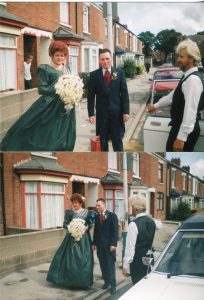
PA : From the side, he was dressed in a blue suit, white shirt, and a little hat as a man. But when he turned round, he was dressed in a pink mini skirt, showing his legs, and he had a blue shoe and a pink shoe, and he looked amazing. And that was his 40th birthday, and people went dressed, fancy dress. And I just said and I’d been invited. And I just said, “Ray, do me a favor, let me have you from the side, not from the front.” And I ant got one from the front, so, but that looks amazing, doesn’t it?
KG : Really amazing.
PA : Yeah. Have you took photos?
KG : Yeah. Yeah. And do you remember the atmosphere then of when all of this was happening?
PA : Electric. The atmosphere was electric because it didn’t matter whether you was going to see Bobby Mandrell or you’re going to see the La Cagelles. Everybody knew there was going to be a good turn. Fantastic. Yeah. I saw my first transsexual there. She’d come on and she was doing all the Ertha Kitt. She was an half cast gal. And she was doing all the Ertha Kitt. And then somebody said, “Are you a tranny?” And she said, “I’m transsexual.” She said, “I’m not a tranny.” So she said, “Oh, because we have trannies in the other room on a Tuesday night.” So she said, “No, I’m the act.” And she’d come from Leeds. And she was amazing. Yeah. And she had blow up boobs.
KG : As in false boobs?
PA : No. As in stuff pushed underneath the skin, you know, operation, silicone. But they was hard because this was the 90s. Yeah.
KG : And can you remember any other acts?
PA : No, they’re the ones that I really remember. Yeah.
KG : And do you remember what they might perform? She performed Ertha Kitt?
PA : Oh, yeah. Well, when Gareth, Gareth, Gavin, when Gavin used to do the La Cagelles, they did it together and then one would stay on while the other one went and got changed. And then that one would come out and do a little act on their own while the other one got changed. But Gavin used to get dressed up as a woman with great big massive boobs and sing a song called “Boobs”. And have you heard it? I can’t remember it. But it did all that and it always come and make me stand up.
KG : Why Pearl?
PA : Because I got big boobs. [laughs] I can’t think of the song. It keeps coming into my head and drifting away again. But, but, yeah.
KG : So it was songs and humour.
PA : Jokes. They used to do Sound of Music and the three Gigi Girls come on dressed as like nuns or Maria. And, oh, well, they used to be Maria and two nuns. And it was amazing. Amazing. You know.
KG : And were they singing live or to soundtrack?
PA : No. It was always soundtrack. None of them could sing, hold a note. But they were very good at lip syncing. Very good.
KG : And who else might be in the audience at this time? Was it couples? Was it gay people?
PA : When they knew there was going to be a gay act, Couples always come. Always. The girls always drank their husbands out. Yeah.
KG : So it was a mixture of people.
PA : And you never, ever got anybody nasty. You never got straight, sidling with gays, nowt like that. Brilliant. Yeah.
KG : And so, at this time also, if we go back to what you said right at the beginning, which was about your brother and your cousin. Were they part of all of this at that time?
PA : Christopher went to Vauxhalll right up until about two weeks before he died. He died in just a few weeks. And he went and he just said, “I’ve come to say tera.” He took every one of his friends and he said, “I’ve come to say Terra.” He said, “You know I’m dying.” And they all said, “Yeah.” “Well, this is my last time.” And there was a lot of tears. But, you know, everybody was glad that it comes to say terra rather than say, “Oh, I wish I’d seen him.” Yeah. And he died. Yeah. Yeah. He was diagnosed on the 30th of November. He was 60 on the 2nd of November. It was diagnosed on the 30th of November and he died on the 6th of February. Yeah.
KG : Terrible.
PA : Yeah. He was a lovely lad. I still miss him. In fact, I’m supposed to have my arm in a sling. And my sling was on here because I was doing some sewing. I took it off. It’s gone. So, my sister said, “Well, where can it go?” Whenever anything disappears, I said, “Christoper, put it back. I need it.” Because things disappear in here and I always blame Christopher. And I say to my sister, “Look, that little Easter egg wan’t there yesterday. But it’s there now. Where’s it come from?” And she’d say, “No, it wasn’t there, wasn’t it?” I said, “Yeah.” And that’s for instance, things disappear and come back few days later.
KG : And why? We’ve often talked about your experiences with how would you describe it? Spiritual.
PA : Yeah. Yeah. Yeah, because I believe in God, I go to church on a Sunday. But I do believe in spirits. I’m not supposed to.
KG : Why?
PA : Because the church don’t believe in them.
KG :But you’ve had very particular experiences?
PA : Yeah. Oh, yeah. Yeah.
KG : So coming back, so Christopher was a regular at Vauxhall. Were you a regular at Vauxhall?
PA : I was a regular at Vauxhall and then Christopher come to live near me? He’d come to live opposite Vauxhall. And I said to him, he said “Well, what you doing in here?” I said, “This has been my local for three or four years.” I said, “What you’re doing in here?” He said, “Oh, it’s a gay scene now, innit?” I said, “Yes” So he said, “What you’re doing in the gay scene?” I said, “Me and Bob’s sitting in the back.” And the back room was for straights. And the front area was for gays.
KG And do you remember it being that divided or did it really matter?
PA : It didn’t matter. It was just that when this guy took cover, he just said, “Look, if anybody doesn’t like the gay scene, the back room has male and female toilets, the gay kids’ll just use the toilets in the big room. No need to worry lads. They’re not going to be after you.” And everybody just laughed. Nobody took no notice.
KG : So tell us about Vauxhall. Oh, I like Vauxhall. I missed it because it closed down and Christopher died. And then my friend’s Sue, she stopped wanting to go out. I told her she was old and boring. But she just got to a stage in her life where she didn’t want to go out. But I would only go to Vauxhall. I don’t even drink. And I said to her, “I’ll drive us there.” But, you know…
KG : So why did you like it? What, what…
PA : Oh, the atmosphere.
KG : Describe it like if nobody’s seen it. What might…
It’s an happy place. Lots and lots of laughing. It in’t because they’ve got drunk at the end of the night. You get lots of laughing. It’s a lovely place to be in. You can see people going in and you can see somebody new’ll come in. “Oh, who’s he, he an’t been in” Oh, same with the girls. Yeah, it’s just a lovely place. Well, it was. I know it’s opened up as a pub again, but I’ve not been in.
KG : So you remember it full of gay people from all over?
PA : Yes, yes.
KG : As well as fishermen or… Any…
PA : Well, the fishing industry had gone down by this time. But people that worked in the fish houses, they’d be there.
KG : Because it was a good night?
PA : It was a good night out. Yeah. If you wanted to watch the act, you’d just come through the door and stood at the bar and watch the act.
KG : And what might the act do in there?
PA : Well, there was an area that would be about this big in the corner of a room and it was a semi-circle. And the act would get up on there and…
KG Perform?
PA : Perform. Yeah. Yeah. I had loads and loads of videos and I tried to find them. I’ve had all my videos put onto DVD and I still can’t find them. So I don’t know if the guy on the, you know, Tony, I don’t know if he only put what was at the beginning of the videos and not what was at the back of the videos. I don’t know.
KG : And so, can you describe maybe some of the costumes that you might have seen on people in there as well as the ones that you were involved in or dress in?
PA : Well, we used to get a group of people that was called clones and they’d just make me laugh. Why would a person want to look absolutely identical to everybody else that’s there? And they got laughed at that much. They had a room upstairs. They didn’t mix with us. They didn’t mix with us at all because they used to come in their chaps, their boots and their waist coats and their leather hats with all the studs in and they all had these moustashes that went down to their chin. You’ve seen them obviously. Yeah. I’ve described them right, havn’t I? And they all walked in and if they went to the bar, people had said, “Oh, it’s like a twin brother.” And so, they didn’t like that people picked on them. Because John, from the La Cagelles, he was a clone. Yeah. And when I saw him dressed up I laughed at him. I said, “John, I can’t imagine you dressed like that. You go to work at Sue’s in a suit. You go dressed up in your fancy clothes and then you come in here on a Saturday night and go upstairs with all the clones.”
KG : Funny times.
PA : Yeah. Yeah. And you got some of the lesbians, lipstick lesbians and you got the other lesbians and I am mesmerized by them. Because the way some of them dress and they really do look like men. Yeah. And them I can’t take my eyes off them. And then you get the others that are just so absolutely beautiful. You think, “What the hell is going on?” Yeah. But each to their own.
KG : Absolutely.
PA : Yeah. And do you ever remember not just trans women, do you ever remember any female performers or, I guess, what we might call drag kings? Like women dressed as men.
PA : Only the one that, yeah, she didn’t dress as a man. She obviously had been a man and now was a woman. She was the only one. I did meet Peter Wilson. And that was real name, his birth name. And he was called Chantelle. But he had the full, full done. And the only thing is, to me, God made a mistake when he made him. Because he was a beautiful, beautiful girl with or without makeup. Beautiful. Yeah.
KG : But you don’t remember any acts like any lesbian acts or?
PA : No, I’ve never seen a lesbian act. No. No. Basically, girls would do.
KG : There was Ruth and the Rudens.
PA : Oh, Ruth!
KG : You see.
PA : Oh, do you know, now Ruth, she was amazing. And Ruth, I used to look at her and I thought she was a bloke. That’s one of the ones I’m talking about. Yeah. But she was lovely. I used to go and see Ruth and the Rudens wherever she was playing.
KG : Beautiful voice.
PA : Oh, I’ve got a DVD of hers around, you know. Amazing. And I had a DVD of her last interview. And I don’t know if it was on, you know, Hull has a screen. I don’t know if it was on there. And I was just flicking through and I thought, oh, that looks like Ruth. And I started watching it. And it was an interview of her when she was dying of lung cancer. And I just felt so sad for her. Because she was so lively and she was so happy and she was fantastic. Did you ever see her? You missed out. She was wonderful. And, you know, if anybody, if any of the blokes had a go at her, quick as a whip. She knew how to pull’em down. Yeah. But she didn’t have to do that much because other people had pulled’em. She was fantastic. She used to sing mainly at a club off Paisley Street. You know, just across road, there, near Walton Street. She used to sing around there somewhere a lot. I only saw when she went into other pubs. Yeah.
KG : So St George’s and Vauxhall. Was there any other pubs that you, obviously Rayners, maybe that you saw acts in? Or you went, or you helped with costumes?
PA : Oh, we did. We didn’t do pubs, clubs around here. We did halls, big places. There used to be one, near Driffield, a great big club. And it was two tier area. And I don’t like strippers. I’d gone for the La Cagelles. And this was when somebody else was dressing him up first. And me and Sue was sat there. And we thought we was safe because we was up high up. And all of a sudden, I saw him look at us and I was off like a rat up a drain pipe. And he got Sue. Slapped his willy in her face. And she was trapped in the chair and she couldn’t get out. She had to get out and there was somebody behind her. And she couldn’t go out. He had a sitting duck.
KG : So there was a stripper. Strippers were always on at the same time but either before or after.
PA : A lot. A lot of the timess. Because the girlss would go for the strippers. But when they saw the La Cagelles, they were class. They weren’t like Bob Mandrell. Because he was an Hessle Roader. He knew they was ladies. He was an Hessle Roader and they was ladies. The dress was amazing.
KG : And so the difference in the act because he’s wearing Hessle Road straight forward. And take people down.
PA : Yes.
KG : Yeah. Interesting.
PA : It was amazing. Last time I went to see Gareth, I was disappointed. Because I was that used to seeing what they did. And as he’s got older he’s not doing. Where? Ray. He’s exactly the same. You know what you’re going to get with Ray.
KG : And it’s going to be good?
PA : Good. Always. Now he is in his 70s. He retired at 70. And he’s had that many people calling him back. That he’s gone. Have you met him? Isn’t he wonderful? When did you interview him?
KG : A few times now, yeah.
PA : Because I said to him, I said a friend of mine called Kate wants to interview you. Did he tell you?
KG : Yeah.
PA : So he said, “Yeah, that’s fine. That’s fine.” Yeah. But he is… He’s hilarious. He is amazing. He was born down in Somerset street, Edinburgh Street. I can’t remember which one. There was Somerset Street and Edinburgh Street run parallel to each other. And my sister went to school with this sister Belle. And he was younger than her. Yeah. And if you see a photo of him and his sister they look identical twins. Ray looks bonnier. [laughs] Ray honestly. Honestly. Yeah. Yeah.
KG : And so from the… I guess thinking about the dressing, when you were dressing, people, you would go with all the clothes or you would… Oh yeah. All the clothes. How would it work? Tell me how it worked.
PA : What would happen was… All John’s, I’ll talk about the La Cagelles. All John’s would be in a great big bag, it’d be… …coat hangers was tied up. And then a big bag, which was a duvet cover, would be put over him. And it’d be John’s name on the front. And Gavin the same. So one side of the dressing room it be John, one side. And what would happen was the guys knew what they was putting on. So they’d start gerring’em on and Sue would just be there fasten the things, furs ‘n everything.
KG : Fun?
PA : Yeah.
KG : Hard work, but fun?
PA : It used to be bedlam when there was both, because they was both on an high and both so excited and all over the place. And so she’d just wait while they’d say, right, fasten me in. Yeah.
KG : So coming back to your brother, because you have talked to me about your brother and that you used to go on bus trips, would it be the bus trips to… You told me about… Would it be St George’s would organize a bus trip to go and see nights out? Or…
PA : That won’t my brother, that was Christopher. Christopher. Yeah. Yeah, we went to a really big gay place and… Well, it was a big dance hall, but mainly gay men and women went. But… There was straights there. And I went with Christopher.
KG : Was it Wakefield way? I can’t remember what… I remember you telling me. Would it be Wakefield? Dewsbury way?
PA : Yeah. Yeah. And I can’t remember exactly where we went. I just know that it was the first time in my life I’d ever seen a strobe light. And there were strobe lights dancing all over the place and they was dancing. Oh, but… And I saw a guy… …a clone. And when he turned around, he didn’t have no trousers on. He had the chaps down the front. But when he turned around, he just had a G string up his bum. Well, I’d seen them with chaps, but he had things on, they had knickers on, but this guy… …just had this spare string up. Yeah. Yeah.
KG : What else do you remember from that night? Strobe lights?
PA : Strobe lights and do you know somewhere I’ve got the photos of us all. And we had… it was amazing. Yeah. They was all gay men. And there was me and my partner at that time and he won’t gay. But the landlord fancied him. Because of, do you know what a bear is? Right. Apparently my Bob was a bear. And the other thing is my Bob turned around and said to… …he used to often have a cuddle with Harry. And he said, “Harry, wrong sex for me.” And so they gor’ on. They gor’ on. And that’s it. Yeah. You was trying…
KG : Was this an organised trip?
PA : Yes. It was organised by somebody. I think it was Captain Potter, had organised it. And Captain Potter he used to wear the traps as well.
KG : And who was Captain Potter?
PA : Captain Potter. We all called him that. Erm… Oo I can’t think of his first name now? But… When Al come to ‘ull, he started coming in the pub. And our Christopher come in’n our Christopher’s sent to him. “An’t seen you for a long time. I thought your wife kept you at home.” And our Christopher had had an affair years. And his wife gave him an ultimatum. You’re either me or you’re on the scene, but you can’t have both. Which I don’t blame her. And so she had two or three kids to him and… …then they split up and he’d come out full gay. And everybody called him Captain Potter. Erm… Erm…
KG : And do you think that was common? Do you remember lots of other men going then having wives or having to pretend to not be gay?
PA :Yeah. Yeah, there was. Yeah, there was. Because it… …they just… …daren’t… I think… …it… …was… …like do you know that actor called Joel Addon, he’s Canadian? Well, I watched his family history. And his grandfather had been a little boy, that worked up chimneys, working for his grandfather. Then as they went further on, they found out he was a marine in the Navy. And then after being a marine 17 years, he went into meltdown. And Jo said, “That sounds to me like his gay.” And said, “Yes.” And the guy that got him to go in the Navy was a sergeant. And his grandfather Robert ended up being a sergeant. And they was working together and some’t happened. Possibly the first sergeant went up with somebody else. But he had a mental breakdown. He was put in an hospital for quite a long time. And he’d actually stabbed the first sergeant. And the sword had gone through his side and… …he’d stabbed him from the back. Because they said the sword came out his tummy. Yeah. And they said he lived. He was okay. And he’d forgiven. And they was friends again. And then after 17 years after that of being in a mental home. Getting hisself sorted. Hed got married to Jo’s great grandmother. And they had children. But Jo said, “I never knew he was gay.” He said, “He might not have been.” But when there was on these ships in these 18 waters, going away for years sometimes, the did sometimes get…
KG : So this… Yeah, I mean, I think that the question which is people were having to live a particular way. Like your… Christopher.
PA : Christopher. Oh, he was lovely was Christopher. Yeah, because in about… It would have been about the… …late 70s. He… …for his father’s sake, his mother had died. He tried to be straight. He met this girl. And they did fall in love. And they had two children. I know that the oldest one was a little boy called Ian. I don’t know what the little girl was called. Because when Christopher was dying, I said, “Do you want me to try and find him?” He said, “No.” He said, “Because if he’s been brought up ok”, he said, “who wants to know that the dads gay?” He said, “No. I’ve never seen him. He’s never seen me since he was a baby.” He said, “We’ll leave it like that.” And so, that’s what we did. Yeah. So he left everything to me. Because our daughter, if I could track his children down, he could leave his money to his children, but… …he didn’t want to. Yeah. He lived down in Boulevard, then a little terrace of Boulevard, in Southside. Yeah. Yeah. Because these kids, obviously, will be 50s. Mm. But like he said, “Who wants to know that there dad was gay?” And Christopher was gay. Oh. There was no hiding it. He was just lovely. Yeah. I loved him to bits. Mm-mm. He had a tin of horse, he used to push it down, push the pedals down, and its legs would go out. And then you released them, its legs would come in. And it propelled you forward. And I used to say to him, “Go get your horse.” And he’d bring his horse’n, and I’d say, “I’m playing on it, you can’t have it” And I’d get on it and I’d go all the way up the street. Hehe. And then you’d have to gerr off turn it round and go all the way back again. Hehe. Erm. It was lovely.
KG : But if you think, I mean, it’s interesting because you were, you know that through the 70s and 80s, there was St Georges and Vauxhall and Rayners that were, some people have described as safe places for…
PA : Yeah. Because that’s what they used to say about Vauxhall. Vauxhall was a safe place because they always had bouncers on the door. And the bouncers was straight men. And if anybody had come in and said the wrong thing, your feet didn’t touch the floor because they’d have yer, “Turn round, out. We don’t need you.” “I was only kidding.” “No. We don’t need you.” And they was chucked out. Yeah. It was good because people in there went for a good laugh, night out and to watch for, I’m a people watcher. So me, I’d get myself in a comfy place where I could see everybody. My cousin, they had her father’s funeral in there. And I was… You could have knocked me down with a feather because I did notice this. She looked very much like you. Gorgeous. And she was, kept putting her hands all over our Amy, and I thought. And then she said to me, “Do me a favour. Go make sure me mam’s all right.” I said, “Alright then our Am’s,then I will.” And I went, and it was so she could relax and I won’t blab. Because my son was still there. And I said to my son, “How long did you stay?” He said, “Oh, you mean after our Amy got rid of yer?” I said, “Yeah.” He said, “We stayed all night. We had a great time.” He said, “Did you notice her bird?” I said, “I noticed, but I didn’t want to…” She’d only got married the year before. She’d been with this guy for about eight years. And she only got married the year before. And I just couldn’t believe it. She came out as soon as her dad was dead. Yeah.
KG : So even then, people were struggling too.
PA : She was his only daughter and she was his little girl. He would not have liked… Not at all. When she told her mom, she told her mom, maybe just before the funeral. And she told her mom that she was gay. And she said, her teeth rattled , because her mother- whack, and walked away from her. Then, her and her mum’s like that again, but she doesn’t live in Hull now. Because she was brought up on Hessle road. She was married twice. She got married when her boys was little. Then, she got married again. And one of her boys was playing for Robbins, rugby. And the other one was… He’s very effeminate, the other one. And he lives with his grandma most of the time in Andhover House in town. And I just don’t think she could cope living here. Because as far as I know, she lives Castleford-way. But it was funny because she went and had a tummy tuck. Because I saw and I said, “Am’s, can’t believe how wonderful you look. Keep it up darling and keep it up.” Because she’d gone from about 25th stone, to about maybe 15. And that was at a her mother’s. Then I saw her in Asda and I put me arm round herand I said, “Amy soon there int going to be owt for me to cuddle.” Because she’s about 45, my youngest is 46. And she’s known me all her life. And I don’t think she wanted me to know. And that’s why she wanted me out the way. But she knows I know now because I’ve been in touch with her. And I said, “Why don’t you talk to me?” She went, “Oh, I didn’t think you wanted to talk to me.” I said, “Well, why wouldn’t I want to talk to you?” She said, “Because of what’s happened” I said, “And?” I said, “Don’t forget, I’ve got a brother that’s gay.” I said, “Yeah, it was a shock for me.” I said, “But we get over shocks.” And that was when she told me that her mother had slapped her face and made her teeth rattle.
There was my brother, where my brother come out to me. He was taking me to, he worked in Leeds. He was taking me to Leeds, to me daughters. And he said, “I’ve got summit to tell yer.” I said, “Go on then, what is it?” He said, “You won’t be happy.” I said, “Go on.” , ”I’m gay.” I said, “What you got to tell me?” He said “What do you mean?” I said, “What you got to tell me? I’ve known you was gay since she was three.” I said, “Everything about you, Brian. Everything.” When my brother chose a colour for his cardigan or jumper it had to be pale blue or white. My other brother, grey or black, so’s it din’t show the muck. He never got mucky. Never got mucky. And so, and he’s still the same.
KG : So why do you think, because my experience of has a road and having done the recordings, lots of people are seeing very accepting, maybe in particular places, very accepting. And, you know, there’s famous people from the area that are gay or have big, and you’re very tolerant. And so there is an experience, a level of tolerance. I see a level of tolerance. But do you think that tolerance is only in certain places, or do you think it’s in certain families? Because to me, the area is very accepting of difference.
PA : I think that Hull is very accepting. I think it’s because of the people coming in and out of Hull, with us being a port. I didn’t know that black people was different to me. And when they all come over in the 50s, I remember going up to a girl in school and doing that. And that was it. She was just the same as me. I’ve got a lot of, I don’t like saying colored, because colored to me is wrong. I’ve got a lot of black friends.
KG : And so you had a very accepting liberal family, and where do you think that would come from?
PA : My mother and my father.
KG : But how had they learnt to become liberal do you think?
PA : Just being, my mother and father was both born in Hull, always. So I think it’s just some’t that’s just inbred in Hull people to be accepting of everybody.
KG : Yeah. Okay, so when you’ve now done all of this talking and you think back on what we’ve talked about and remembering these stories from your life, how does it make you feel to remember and speak of these stories?
PA : I feel good. I feel good about my life. I’ve had a lovely life. I’ve met lovely people. And if they’re not nice people, they’re not in my life. Only nice people are in my life. Yeah. I just… I just like my life.
KG : Thanks Pearl.
PA : Thank you.