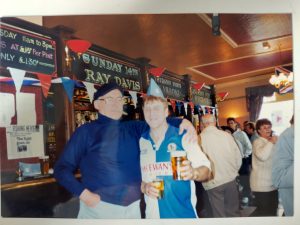
00:03 Layla Jabbari: Okay, I’m Layla Jabbari, and I’m here talking today with Sue Radford, at Hull Bullnose Fishing Heritage centre on Boulevard, um, it’s the 4th of March, 2025, and we’re recording for Hull Scene But Not Heard. So Sue, just wanted to start a bit, could you tell me a little bit about yourself, where you come from?
00:23 Sue Radford: Yes, uh, I’m Sue Radford, uh, came from Hessle Road, uh, Gordon Street off the Boulevard, um, worked on Hessle Road most of me life, uh, worked for the Marrs Fishing Industry for 37 years, uh, until I retired. I’ve been a volunteer at the Hull Fish Bullnose Heritage Centre, um, doing little bits for them for the past 10 years, um, but now I am a trustee at the centre, um.
01:01 LJ: Can you tell me a little bit about Marrs, what was the Marrs?
01:04 SR: Uh, I did the payroll at Marrs-
01:07 LJ: Uh-huh (affirmative).
01:07 SR: -um, and involved with all the factory, I used to sometimes do the Christmas parties-
01:14 LJ: Oh, nice.
01:15 SR: -for the staff one night, and for the factory staff another night, um they were all quite happy with it, we used to take the children to pantomime every year, and we used to do raffles to get them sweets and ice-creams at the pantomime. I got involved very ‘eavily with it, really, you know, I did enjoy it, like I enjoy coming here, um.
01:45 LJ: Is it very much part of your social circle?
01:49 SR: Uh, Marrs was and I still see the girls to today, and a week on Saturday I’m going to one of the girls’ daughter’s 21st birthday party-
02:00 LJ: Oh, lovely.
02:00 SR: -out of the factory. They still always invite me to weddings and engagements and birthday parties, uh, for their children, uh, because I always spoke to the girls that worked in the factory, and I used to say to them, “if you didn’t do your job then I couldn’t do mine,” so there’s no animosity between us and that was how I got on with them so well.
02:29 LJ: Great. Can you tell me a little bit about growing up on Hessle Road on Gordon Street?
02:33 SR: Yes, um, my grandma lived on the Boulevard, and my mum’d always lived round there, she was born on the Boulevard, and, um, my granddad was a Royal Navy officer and, um, my mum, when she first left school, she worked in the offices at Tullman Wilson Line, um, we, uh, had a good life on Hessle Road, uh, everybody was so friendly, um, everybody was in one of those houses, uh, you never locked your doors because there was no need to because everything was so… Everybody, we were all brought up the same. None of us had a lot of money in those days, so my grandma, she used to help my parents because my mum, uh, she was married to a fisherman at first, and he got lost at sea, and she had a son and a daughter to him, and then she married my dad, and there was seven of us besides my step brother and sister.
03:42 LJ: Oh, okay.
03:43 SR: So there was a big family, so we got help from grandparents, which is natural, you know, um, my mum used to make a lot of our clothes and knit a lot of our cardigans and jumpers and passed all those on to us. I used to, when I got older, make my clothes and knit my jumpers and things like that, so that was the way that you would be dressed nicely, because my mum sat at the sewing machine making clothes when we were children, so, but we had a good life, and we lived opposite the police station, and they were very friendly, you know, uh, if we had any problems, we could go across there. They were really nice. Not like the policeman left today, they were sort of involved in the Hessle Road, um, there used to be one and ‘e used to walk Hessle Road all the time, and if I was walking to work, he would sometimes walk along with me, but that’s the way they were in them days.
04:56 LJ: Mm-hmm (affirmative).
04:56 SR: Uh, when I first started work, I was telling the lads, I started work and it was about forty hours a week and my wages was three pound, two shillings, and some sixpence a week, but I was quite happy because I ‘ad a job, you know, I mean, that was the main thing once you grow up and you know, and I used to, my hobby was roller skating, which was winter time at Medley Street Baths, they used to, what they used to do is the swimming pool they used to put a wooden floor over it in winter and we used to go roller skating, and I had, uh, the white boots, the leather boats with the skates and that was my hobby until I met my husband. I met my husband when I was just turned eighteen.
05:44 LJ: Okay. How did you meet your husband?
05:47 SR: He came into the roller skating with a friend, and I was, because I could dance on me skates as well, and, uh, ‘e came up to me and asked me if he could walk me ‘ome, and I married ‘im six years later.
06:03 LJ: Aw.
06:04 SR: So that was life, you know, in those days, um, we used to drink along Hessle Road, uh, on a Friday we used to start at top end of Hessle Road, which we called Dick Rites, the pub, and then we used to walk down and we used to sometimes go in Rose Tavern, Sheffield Arms, and then we used to come down, and we used to go into Criterion, and then we used to go to Halfway, and then we used to walk across the road where the Volvo Garage used to be, and we used to get on the bus and go to Ferryboat at Hessle, because they were open ’til late.
06:50 LJ: Yeah. Mm-hmm (affirmative). Right.
06:52 SR: And that used to be our Friday night out after we’d been to work all week.
06:57 LJ: Mm-hmm (affirmative). Okay.
06:58 SR: Um, you got, as Jerry said, all the fishermen, uh, well, some of the younger ones used to come into the skating about nine o’clock, you know, they’d had a couple of drinks, and they’d come in there and talk to the girls and sometimes take some of ’em ‘ome, you know, uh, and they were all, they were good lads, they worked hard, and it was hard work, and it was so sad, because I knew so many that got lost, you know, and never came home. It was so sad, um, but Hessle Road life was, well, it was just wonderful, because everybody knew everybody. We used to go in the shops, and you always knew them, you know, first name terms, you know? And it was just so nice.
07:50 LJ: Mm-hmm (affirmative). Can you tell me a bit about how would a night, so on a Friday night, how would, what would be, would you go out with your friends, or?
07:58 SR: Yes, yeah, with a girlfriend, yeah, yeah.
08:00 LJ: Uh-huh (affirmative).
08:00 SR: ‘cause we used to go in the pubs at sixteen then [Layla chuckles], and, but as long as you behaved yourself, nobody bothered.
08:07 LJ: Mm-hmm (affirmative).
08:07 SR: You know, I mean, along here, as soon as people left school and went to work at fifteen, they went into the pubs, and, but as long as they were, which we never ‘ad any bother, you know, I mean, when I was nineteen, I worked at the King Edward in town upstairs. I had a day job in an office, but I wanted to save up for a car, and the only way I could do that was by having another little job.
08:37 LJ: Mm-hmm (affirmative). Yeah.
08:38 SR: And so I went to work at the King Edward in the town, and all the young fishermen used to come in there, um, you know, and they were really generous. They came in there, and they used to say, they used to order their round of drinks and they used to say, “and one for yourself.”
08:58 LJ: Yeah.
08:58 SR: And the landlord said to me, when I started working there, Percy, ‘e said, “so,” ‘e said, “if anybody buys you a drink, you don’t have to ‘ave it.” He said, “just get up, take the money for a bottle of pale ale, put it under the counter in this section that’s yours,” and he said, “at the end of the night, I will pay for those,” so I made a little bit of money that way as well, because all the fishermen as they came in, as I say, they were so generous, if they ordered a round, you got a drink as well, you know, they were good lads, you know, they weren’t frightened to spend the money when they were ‘ome, because they never knew when they went away if they was going to come back ‘ome.
09:41 LJ: Mm-hmm (affirmative). Yeah. Do you think that affected the atmosphere? Do you think that’s why it was such a, like?
09:45 SR: That’s why everybody on ‘essle Road was so close.
09:48 LJ: Mm-hmm (affirmative).
09:48 SR: I mean, we knew all the shops. You knew everybody that owned the shops, well, that worked in the shops, you knew everybody, and like ‘enry ‘irds, I’ve still got my watch what my mum and dad bought me for my 21st birthday from ‘enry ‘irds.
10:04 LJ: Wow.
10:05 SR: You know, so it’s all so nice, you know what I mean? Because Henry Hirds, all the fishermen went in there and bought things, and to this day, they still do, you know, you still get them going across to Henry Hirds, because we know them, you know, which is so nice.
10:26 LJ: Yeah.
10:26 SR: You know.
10:28 LJ: Yeah.
10:29 SR: The, as I say, all the pubs along ‘essle Road, everybody was so friendly, and they was always so full every night of the week. I mean, we used to go out Friday, Saturday, and Sunday, and I always had to be an early Sunday because I had work next day, and my mum and dad was a bit strict about that, that I ‘ad to be in by eleven o’clock on a Sunday because I had work next day.
10:57 LJ: Yeah.
10:57 SR: But on a Friday and Saturday, if we was going to maybe one of the, well going up to Ferryboat on a Friday, there was, they used to ‘ave live groups on, and so you could get up and dance and everything, and it used to be open ’til late.
11:13 LJ: Yeah.
11:14 SR: So they had a late license, and, uh, because it wasn’t near any ‘ouses or anything, it was near the river, um, and so nobody bothered.
11:24 LJ: Yeah. Yeah.
11:25 SR: So you could have a good time there, and we used to go down there.
11:28 LJ: Yeah.
11:29 SR: And relied on somebody giving us a lift back into his Hessle [they both chuckle], because it was a long walk.
11:35 LJ: I bet.
11:35 SR: When you’d ‘ad a drink. [they both laugh] But I mean, I didn’t drink a lot, you know, but, I mean, if I felt I’d ‘ad enough, I would maybe ‘ave lemonade.
11:47 LJ: Mm-hmm (affirmative), and what were you drinking then, what sort of drinks were there?
11:48 SR: Well, usually a lager and lime, always a lager and lime, so, but if I’d ‘ad enough, I knew I’d ‘ad enough, then I would ‘ave a lemonade.
11:59 LJ: Uh-huh (affirmative). Mm-hmm (affirmative). Mm-hmm (affirmative), okay.
12:00 SR: So because if I had too much and I went home, me mum and dad didn’t like it [they both chuckle], so you ‘ad to be careful what you ‘ad.
12:12 LJ: Yeah. Did your mum and dad go out on Hessle Road, or would they not so much?
12:15 SR: No, they didn’t really drink a lot, do you know what I mean? It was on only occasions when my mam and dad went out, you know, my mam dressed very nicely, you know what I mean? She always did, and she always had her hair done every week at the hairdresser’s, every Saturday morning she’d go and get her hair done, but she always worked, me mum, so, they didn’t have a lot of time, me dad was a long distance lorry driver.
12:44 LJ: Mm-hmm (affirmative). Mm-hmm (affirmative). Mm-hmm (affirmative). Mm-hmm (affirmative). Yeah. Oh, okay.
12:44 SR: So ‘e was away from home a lot, you see?
12:47 LJ: Yeah.
12:47 SR: So, they didn’t have a lot of time to go out, they used to occasionally go to pictures, things like that, you know? Um, and they sometimes, when they made friends, they would go out for a night out, you know, but not all the time.
13:01 LJ: Mm-hmm (affirmative). No.No.
13:02 SR: You know.
13:03 LJ: Yeah.
13:03 SR: So, because there was a big family, and we didn’t have the money to waste.
13:07 LJ: Yeah. And where did your mum work?
13:09 SR: She worked, she did, um, she worked for Flasher’s the dentist, a cleanin’ job.
13:15 LJ: Okay.
13:15 SR: Uh, she worked for, uh, Harold and Dorothy Flasher, and got on really well for, I mean, after she retired, they used to bring her a Christmas hamper every Christmas.
13:25 LJ: Aw, that is-
13:25 SR: You know, so, it was real nice, you know?
13:28 LJ: Yeah, yeah.
13:28 SR: And through marriage, we ended up being related to them, because my Auntie Dolly married their uncle.
13:38 LJ: Oh [she chuckles].
13:38 SR: So, in the end, we ended up related to the Flashers, you know, so it was really strange.
13:45 LJ: Yeah, yeah.
13:46 SR: ‘cause I went into the dentist to get me teeth done, and there was a picture on ‘is table, and I said, uh, “That’s my Auntie Doll,” so, ‘e said, “Well, it’s my Auntie Doll,” so, I said, “Oh, right,” so, I said, “She married John, um, John Jacobs,” they used to have furniture shops in the town, and Holderness Road, so I said, “Well, it’s my Auntie Doll,” so, ‘e said, “Well that makes us a little bit related, doesn’t it?” ‘e was laughin’ about it, you know? ‘Cause it, I’m going there to get me teeth done, you know?
14:24 LJ: Yeah, yeah.
14:24 SR: And we end up talking about that, but yeah, I mean, all these pubs on Hessle Road, every Friday, well, every night at the week, they were really full, and you used to get artists like, uh, Joe Longthorne.
14:39 LJ: Yes.
14:40 SR: Um, ‘e used to go into the club down West Dock Avenue and sing, and Rina Jordan.
14:47 LJ: Okay.
14:47 SR: Now, I still see Rina now.
14:49 LJ: Right.
14:49 SR: Um, she did a charity event for us at Ryder Club not so long back, [phone rings] that’s my phone now, I’ll ignore.it.
14:57 LJ: Are you sure?
14:58 SR: Um, I, so, we still keep in touch, we, um, there was something to do with the mice on at Walton Club not so long back, and Rina did a charity event from there, so.
15:14 LJ: Okay. So, can you tell me a bit about when you went to see Rina perform? What would that be?
15:19 SR: Oh, yeah. She was really good.
15:20 LJ: Yeah?
15:20 SR: Really, really good. She used to perform all the clubs, but she still does some charity events, as I said, for the mice, but she doesn’t do the clubs and pubs now anymore, ’cause she’s like my age, you know, you get past it, don’t you? You know. Well, her ‘usband, I think he’d had enough. [inaudible] 15:39 But, uh, yeah, she still does the charity events, and if we do a charity event, she’ll come and do it for us, so, when we did the, we did, um, 2019, we did a Hessle Road reunion at Ryder Club, and she did the charity event for us there, which was really good, but I mean, Joe was good as well.
16:00 LJ: Yeah. Uh-huh (affirmative). No. Mm-hmm (affirmative). [she chuckles] Right. Mm-hmm (affirmative). Oh. Yeah.
16:00 SR: You know, I mean, ‘e, when ‘e was a child, he lived on Woodcock Street, and I lived Gordon Street, you see, which it moved along into Woodcock Street at Division Road, and I used to see ‘im quite along, and I knew ‘s sister.
16:16 LJ: Okay. Oh, awesome. Mm-hmm (affirmative). Right.
16:17 SR: Yeah, she, ’cause he had a sister that was my age as well, you see.
16:20 LJ: Okay, right.
16:21 SR: Uh, Lizzie.
16:22 LJ: And where would he perform? What sort of clubs would he be in?
16:25 SR: He’d go in the pubs and clubs on Hessle Road, just-
16:28 LJ: Just, every, yeah, yeah.
16:28 SR: Yeah, yeah, and Mike Lodge was the same when he first started. I mean, but Mike was really good.
16:34 LJ: Mm-hmm (affirmative). Yeah.
16:35 SR: You know, I mean, he used to do some, uh, at Tiger’s Lair on Anlaby Road, and we used to go see ‘im quite often.
16:43 LJ: Okay.
16:44 SR: You know, so ‘e was, ‘e was good, was Mike, and ‘e used to drink in the pubs on ‘essle Road, anyhow.
16:50 LJ: Mm-hmm (affirmative).
16:51 SR: ‘e used to go, um, they used to do all the pubs on ‘essle Road and ‘e used to end up on the new estate in, uh, one of the pubs, ’cause a friend of mine was a barmaid there, um, Esther, Esther Brantano, she was a barmaid at, um…
17:09 LJ: Uh-huh (affirmative).
17:10 SR: I’m just trying to think of the name of the pub. Kingfisher.
17:15 LJ: Oh, okay.
17:18 SR: Now that’s not a pub anymore, but, uh, she was barmaid there for years, you know, so, and she’s, when we all used to go out together, she still used to go out with us, but I still see ‘er now, you know, cause she’s an ‘essle Road girl, and she comes on to ‘essle Road and we, she’ll pop in ‘ere and see me and, um, like some of the girls that I went to school with, they’ll come in and buy raffle tickets ‘ere and things like that, and you have a chat with them, do you know what I mean?
17:48 LJ: Mm-hmm (affirmative). Right. Yeah. Have you always lived in Hull?
17:49 SR: Yes.
17:50 LJ: And on, and in this area?
17:51 SR: Yeah.
17:51 LJ: Wow.
17:52 SR: Always, yeah.
17:53 LJ: Yeah.
17:53 SR: I lived here ’til I got married.
17:56 LJ: Mm-hmm (affirmative).
17:55 SR: And then when I first got married, I lived off Hawthorne Avenue, and then I moved up to Gilberdyke, in a new little bungalow.
18:02 LJ: Mm-hmm (affirmative).
18:03 SR: And then when I had me daughter, we came back in to Hull, um, we lived in Anlaby.
18:10 LJ: Mm-hmm (affirmative).
18:11 SR: Um, we’ve lived in quite a few places. I live in Hessle now on the main Boothferry Road, Hessle, which isn’t very far away.
18:20 LJ: Mm-hmm (affirmative). No, no.
18:21 SR: You know.
18:21 LJ: Yeah.
18:23 SR: [sirens in background] You still, ’cause most of the people that moved from Hessle Road, a lot of them moved t’ Hessle, a lot of them moved onto Boothferry Estate when the new estate was built, and then a lot of them that did a little bit better for theirselves moved into houses and bought them theirselves in Hessle, you know what I mean?
18:41 LJ: Mm-hmm (affirmative).
18:41 SR: So I still see ever such a lot of people that I know, and on Hessle Road, when I walk on Hessle Road, I see that many people I know, it’s unbelievable, ’cause all the girls out, and the lads out the factory are still accumulate on Hessle Road, you know what I mean?
19:00 LJ: Mm-hmm (affirmative).
19:01 SR: So some of ’em still work on ‘essle Road, you know, uh, some of ’em work at, uh, the fish merchants that are still going, like Simpsons, uh, a lot of the lads from Marrs work at Simpsons, you know, so you still see a lot of them.
19:15 LJ: Mm-hmm (affirmative). Mm-hmm (affirmative).
19:15 SR: You know, but life was really, really good in those days on Hessle Road, you know what I mean? Like I said, none of us had a lot of money, but we all, we were all friends, you know? I mean, there was a lot of girls … when I went, I went to Constable Street School, and a lot of the girls that went to school with me lived on Hessle Road, so they lived these streets along ‘ere and along this way, so I mean, I’m still friends with quite a few of them.
19:46 LJ: Yeah. Mm-hmm (affirmative). Right. Mm-hmm (affirmative). Yeah.
19:48 SR: And me best friend that comes to my house every week, uh, Mavis, she was Mavis Reece, now she’s Mavis Rolfe, uh, she gets a little bit involved here as well, she does, um, a Christmas cake every year for our raffle, you know, um, which is nice, and we’ve been friends since we was children.
20:10 LJ: Right, okay.
20:10 SR: And we still see one another every week.
20:13 LJ: Yeah.
20:13 SR: And we still go out together. So it’s really nice, you know?
20:17 LJ: Yeah.
20:19 SR: So…
20:19 LJ: Do you think-
20:20 SR: -our first ‘oliday abroad was together, in ninety … let me see … ’64 1964, we went to Spain on holiday, four girls, uh, Mavis, ‘er sister, and another friend, Janet, who was a hairdresser, so we had two hairdressers with us, so we was lucky, [they both chuckle] and Mavis still cuts my hair to the, now, you know? So she’s always been a hairdresser.
20:55 LJ: Oh. Oh. Yeah. Yeah, yeah. And when you went to Spain, did you notice a difference going out there to coming back here?
20:59 SR: Oh, the culture was so different.
21:00 LJ: Yeah?
21:00 SR: Yeah.
21:01 LJ: Yeah?
21:01 SR: Uh, even different to what it is now, because it wasn’t so built up then in those days as what it is now, you know, I mean, friends and neighbours that live round near us, they was all so excited to think that we were going abroad on ‘oliday. 1964, people didn’t do it, you know, and ’cause I mean, it wasn’t the in thing, but like I say, we did it, and I never looked back really after going away. Mike and I started going away when I started going out with ‘m, we started going away together, you know, abroad, and well, we’ve been all over. I mean, we’ve done, well, we did right across the west coast of America, um, we’ve done Florida, we’ve done all over. We did the Fjords cruise, and we’ve cruised all over the Mediterranean, you know, so we’ve been to Malta, we’ve been to, uh, well, we’ve been just about every place in Spain that you can think of, because when you go on the cruises, they stop at all the different places, you see? So, and, well, my ‘usband passed away two years ago, um, and we’d been married 52 years, so, but, you know, ‘e was a quiet lad. I was more outgoing than him. ‘e was quiet and reserved, very smart, always. I mean, the lads here say ‘ow was smart, you know.
22:43 LJ: Uh-huh (affirmative). Mm-hmm (affirmative). Yeah. Mm-hmm (affirmative). Mm-hmm (affirmative). Yeah. Mm-hmm (affirmative). Mm-hmm (affirmative). Yeah. Wow. Mm-hmm (affirmative). Mm-hmm (affirmative). And did he work in the fishin’ industry as well?
22:44 SR: No, no, ‘e worked, um, ‘e worked, well, when we got married, ‘e was working up at Capapassa, Ferriby.
22:52 LJ: Okay.
22:53 SR: Where they had all the problems and had to close it down.
22:56 LJ: Right.
22:57 SR: ‘e worked there for twenty-odd years, and they always, my family always said that’s part of why he passed away so young, really, because he was only 76, you know, so yeah, but, uh, yeah, ‘e worked there for a lot of years, and it had a lot of bad reputations, and…
23:20 LJ: I don’t know anything about it.
23:20 SR: Oh, no. It was a smelting plant-
23:25 LJ: Right.
23:25 SR: -and they used to bring heavy metals from all over to there, and, well, they reckoned, well, the reason it got closed down there was lots of bad reports about it, uh, saying that it had caused a lot of childhood cancers in the area, and, I mean, a lot of the men that worked there, died of cancer, Mike’s younger brother did, ’cause he went, after Mike went there, ‘e went to work there as well, so, and ‘e died of cancer, he was only about 73, I think, 72, 73, I think, which is young, i’n’t it? You know. It is by today’s standards, because, I mean, my mum and dad lived good lives. My mum was 91, and my dad was an 93. So they had long lives, you know, and Mike’s mum was 92, Mike lost ‘is dad when ‘e was ten years old, in a road accident, uh, but ‘is mum never remarried, she brought the three boys up on ‘er own. .
24:33 LJ: Mm-hmm (affirmative). Oh. Mm-hmm (affirmative). Yeah. Mm-hmm (affirmative). Yeah, yeah. Mm-hmm (affirmative). On Hessle Road, was he?
24:35 SR: He, well, no, ‘e lived ‘awthorne Avenue.
24:37 LJ: Okay.
24:36 SR: Um, Greek Street, ‘awthorne Avenue, uh, but, ‘e frequented Hessle Road.
24:43 LJ: Yeah, it’s not far, is it?
24:43 SR: Because all ‘is friends did.
24:46 LJ: Mm-hmm (affirmative).
24:46 SR: You know, ‘e used to go to the gym on ‘essle Road and things like that, so … ’cause ‘e made me laugh when I first met him, because he said that they’d been out running with the gym, and they used to run along Hessle Road up to Regent Street and back to, um, Somerset Street, and ‘e said that ‘e’d seemed me walking home with my white roller skate boots on me shoulder, and ‘e said to his friend, “Do you know that girl over there?” ‘e said, “Well, no, I don’t know, but” ‘e said, “I wonder where she’s been to?” ‘e said, “Oh, she’ll have been to skatin’ at Medley Street, she’s got her boots on her shoulder.” ‘Cause I used to put ’em over me shoulder. Uh, so he said, “Where is it?” ’cause ‘e didn’t know anything about it.
25:33 LJ: Yeah.
25:33 SR: So he said, “Oh, it’s at Medley Street Baths,” he said, “when we’ve been for a drink tomorrow,” he said, “we’ll go, we’ll go there.”
25:42 LJ: Yeah.
25:42 SR: So the, ‘is friend’s mum and dad had Rose Tavern at the time, so they’d been in there and ‘ad a couple of drinks, and then they came to the roller skatin’ and that’s ‘ow I met ‘im.
25:51 LJ: Oh, that’s lovely.
25:52 SR: So…
25:53 LJ: Yeah.
25:54 SR: Yeah. But ‘e’d seen me the night before. We always laugh about it, you know, ‘e thought, “I want to meet ‘er.” Which is nice, you know.
26:04 LJ: Lovely. Yeah, really lovely.
26:06 SR: Yeah.
26:06 LJ: And so did you go out together? Would you go out drinking together along, as well?
26:10 SR: Yeah, yeah.
26:11 LJ: Yeah, yeah.
26:11 SR: I’d still go out with me friends, but we used to go out for a drink. We used to go in ‘awthorne, pub on ‘awthorne avenue-
26:20 LJ: Mm-hmm (affirmative).
26:19 SR: -and then sometimes Silver Cod on Anlaby Road.
26:23 LJ: Okay, yeah.
26:23 SR: Um, I always remember when we’d been to the church to, uh, all organised … You used to have to go in so many weeks before you got married, and, uh, I was getting married at the church at top of Plane Street.
26:37 LJ: Okay.
26:37 SR: On Anlaby Road, and, ’cause that was Michael’s church, um, and so we were gettin’ married there, and we’d been to the Sunday service on the Sunday night, and when we got in Silver Cod, the vicar’s sat in Silver Cod as well [they both laugh], and I said, “Oh, the vicar’s sat over there.” He said, “Oh, well, they are allowed to drink, you know,” [they both laugh] but it was so funny, you know, we’d been in the church with him, and then he was sat in the pub, you know, and we laughed about it, yeah.
27:09 LJ: Yeah. Brilliant.
27:09 SR: So, yeah, I mean, we did drink, well, I drank more on ‘essle Road than my ‘usband did, because I, all my friends did as well, you see.
27:19 LJ: Mm-hmm (affirmative).
27:18 SR: So, but, uh, yeah, I used to go in Kingfisher sometimes, um, because, well, a lot of the fishermen used to go in Kingfisher.
27:28 LJ: Mm-hmm (affirmative).
27:28 SR: You know, they all used to go in anyhow, um, and a lot of the lads off Hessle Road went in as well. It was a really popular pub.
27:36 LJ: Yeah. Whereabouts was Kingfisher? Did you say it was-?
27:38 SR: It was you know the new estate up Hessle Road?
27:42 LJ: Uh-huh (affirmative).
27:42 SR: Where the flats are and all the new houses. It was on there.
27:45 LJ: Right, okay.
27:46 SR: But it, as I say, it closed down.
27:48 LJ: Mm-hmm (affirmative).
27:48 SR: Um, but it was due to the recession, really, wa’n’t it? You know, I mean, a lot of the pubs, like Jerry said, they only open on a weekend now.
27:58 LJ: Yeah.
27:58 SR: But they used to open seven days a week.
27:59 LJ: Yeah.
27:59 SR: And, but it used to be eleven ’til three.
28:03 LJ: Right.
28:03 SR: And then seven ’til eleven.
28:04 LJ: Okay.
28:05 SR: That was the pub times.
28:06 LJ: Yeah, yeah.
28:07 SR: Yeah.
28:07 LJ: And eleven ’til three was that?
28:10 SR: Afternoon.
28:11 LJ: Yeah, and you’d, sort of, like an after lunch thing, or did you go over for food, or was not there really food in bars?
28:15 SR: No, there wa’n’t, no, in them days.
28:17 LJ: No.
28:18 SR: I mean, my aunt and uncle ‘ad, um, Victoria Tavern down Chapman Street, near Ricky’s.
28:23 LJ: Yeah.
28:24 SR: Um, and my aunt used to do sandwiches and things like that.
28:28 LJ: Right.
28:28 SR: But a lot of pubs never.
28:31 LJ: Okay.
28:31 SR: You know, but from there, they went to the Royal on New Bridge Road where she did, uh, like the baskets of chips and sandwiches, and she used to get a lot of people in on a lunch time because of that.
28:46 LJ: Mm-hmm (affirmative). Yeah. Yeah.
28:47 SR: ’cause that was a really big pub, was the Royal, which is still open now. I don’t think they call it the Royal, but it is still open, uh, but like my uncle, who was the publican, ‘e did stints, ‘e used to relieve at Rayner’s.
29:08 LJ: Oh, okay.
29:09 SR: Yeah, and Wassand Arms.
29:12 LJ: Yeah. Yeah.
29:14 SR: Yeah, I mean, it’s Strickland Arms is still open.
29:16 LJ: Uh-huh (affirmative). Okay.
29:18 SR: So, yeah, you know, we used to go in there sometimes. I mean, wasn’t the … me and the girls went in there, it i’n’t that many years ago ’cause there was a charity do on.
29:29 LJ: Mm-hmm (affirmative).
29:29 SR: And we used to go in there to anything like that that was going on, we used to go to a lot of charity events, so, it was really nice, but Strickland Arms still gets a lot of people in.
29:40 LJ: Yeah. Right, okay.
29:40 SR: But Wassand Arms is closed. I mean, when we was at work, at Marrs, those girls in the office, on a Friday, we used to go to Wassand Arms, uh, last, the last Friday of the month when it was payday, and we used to go for our lunch at Wassand Arms because they used to do fish ‘n’ chips and they used to be beautiful [Layla chuckles], you know, and we also always go on the last Friday of the month.
30:04 LJ: Yeah.
30:04 SR: So, it was really nice, fish ‘n’ chip day at Wassand Arms [she chuckles]. 30:08 LJ: Nice.
30:09 SR: So, yeah, you know, I mean, I really enjoyed all of my life, really, on ‘essle Road.
30:14 LJ: Yeah, yeah.
30:15 SR: You know, I mean, it was a good life. Right up to, well, right up to getting married really, I still come on to ‘essle Road, and I still come on to ‘essle Road to this day.
30:26 LJ: Yeah. Yeah. So, that, what time was that, would you say, when you were goin’ out frequently on Hessle Road? What, when was that, would you say?
30:35 SR: Well, it was from bein’ fifteen, some of … To be honest. [Layla chuckles] So, that would be, uh, ’61 when I left school.
30:46 LJ: Okay.
30:47 SR: 1961 when I left school.
30:49 LJ: Uh-huh (affirmative).
30:49 SR: Um, automatically, people that you worked with, when it was Christmas time, the last day, they all went to the pub.
30:58 LJ: Yeah.
31:00 SR: So, even though you was only fifteen, you went with them.
31:03 LJ: Yeah.
31:03 SR: Do you know what I mean? Uh, but like I said, nobody bothered because we didn’t, we behaved ourselves.
31:11 LJ: Mm-hmm (affirmative).
31:11 SR: You know?
31:11 LJ: Yeah.
31:12 SR: I mean, if you behaved yourself, you were fine, and I mean, the police never bothered.
31:18 LJ: Yeah.
31:18 SR: You know, I mean, they never bothered because everybody behaved themselves.
31:22 LJ: Yeah. Is it ’cause it’s part of the community to be in that space?
31:27 SR: Yeah, yeah. It was, yeah. I mean, it was all part of the community, everything that you did on ‘essle Road, you know, I mean, Clothin’ ‘ouse, they sold … everybody went to Clothing ‘ouse and bought clothes.
31:40 LJ: Mm-hmm (affirmative).
31:40 SR: Uh, there was a men’s Clothing ‘ouse, and there was a ladies’ Clothing ‘ouse, and used to, on a night time, none of the shutters was on any of the shops, so, you could look in the window, so you’d look in the window, and you’d see a really nice dress or a pair of shoes.
31:57 LJ: Yeah.
31:57 SR: And you’d think, “Oh, I might have that at weekend.” [Layla chuckles] You know? And that’s how it was
32:02 LJ: Yeah.
32:02 SR: And you and your friend would go in there, do you know what I mean? 32:04 LJ: Yeah.
32:05 SR: And then you’d go in there and you’d get yourself a new dress and you’d think you was really, really, you know, because you’d started work, and you ‘ad a little bit of money, you know.
32:14 LJ: Yeah. Can you tell me a little bit about the outfits that you would wear?
32:16 SR: Oh, mini skirts.
32:18 LJ: Mm-hmm (affirmative).
32:20 SR: Yeah. Really short mini skirts, you know.
32:22 LJ: Yeah.
32:23 SR: Um, and high heels.
32:24 LJ: Yeah.
32:25 SR: Yeah. Really, I wore really, being small. I wore really high heels always, so, um, yeah, and always really short skirts, ever so short, you know? I mean, my mum used to say, “Are you putting some clothes on?” and I used to say, “I’ve got ’em on!” You know? And she used to say, “Well, that’s a bit short,” and me dad was real quiet, ‘e never used to say anything.
32:54 LJ: Aw. [they both chuckle]
32:54 SR: I mean, I can always remember when I first started going out with Mike during the week. I ‘ad to be in at ten o’clock.
33:02 LJ: Right.
33:03 SR: Because we had to be up for work during the next day, and, uh, I can always remember ‘im walkin’ me ‘ome, and we was stood at, on my front doorstep in Gordon Street, and my dad opened the door and ‘e said, “Youse two,” and ‘e said, “It’s ten o’clock. It’s time you’ve got yourself in. It’s work in the morning,” and I was eighteen. [They both laugh] Which was really, really funny, you know?
33:29 LJ: Yeah, yeah, yeah.
33:30 SR: It is funny, i’n’t it? Because nowadays, at eighteen, they’re married and they’ve got children and everything else, you know?
33:38 LJ: Mm-hmm (affirmative). Yeah, yeah.
33:40 SR: But, uh, yeah, the, life was so different then, you know?
33:43 LJ: Yeah.
33:44 SR: I mean, my parents were a little bit strict, really.
33:48 LJ: Uh-huh (affirmative).
33:47 SR: You know, um, obviously, with girls, especially, you ‘ad to be.
33:53 LJ: Yeah.
33:52 SR: I mean, I only had one sister, and she was three years older than me.
33:58 LJ: Mm-hmm (affirmative). Would, did she go out as well, or in this area, yeah?
34:02 SR: Yes. She used to frequent the pub, Lion, Redmond Street.
34:07 LJ: Okay.
34:08 SR: Um, which wa’n’t far away, but she went out with one or two fishermen, you know. I mean, I won’t say that I never let any fisherman walk me ‘ome, because I did, but, it … and I went out with them, and we also sometimes go into a club down ‘arris Street, uh, and it was alright in there, but it was always full of fishermen.
34:30 LJ: Right. What was that one called? Do you remember, or?
34:31 SR: Um, I can’t remember. There used to be, um, a betting shop at the top of it. I can’t remember the name of it.
34:41 LJ: No, no, no.
34:42 SR: But it, yeah, we used to go in there, and it was, that was always full of fishermen.
34:45 LJ: Mm-hmm (affirmative).
34:46 SR: Um, there used to be a club at, the, uh, Gillett Street Club, um, used to go up these metal steps at, to the club, and one of the ex-rugby players used to run it.
34:58 LJ: Okay.
35:00 SR: So it was alright in there. Well, when I worked at Marrs, we all used to go there at Christmas time when we left work.
35:07 LJ: Oh, right.
35:07 SR: So it was all up there, you know?
35:09 LJ: Yeah.
35:10 SR: And I said to Jerry a few weeks ago, I’ve seen a few people fall down them stairs when they’ve ‘ad too much to drink! [they both laugh] Because we chat about ‘essle Road, you know, and ‘e says, ’cause like everybody that comes in here, ‘e says, “Oh, you know everybody that comes in ‘ere!” But it’s because I’ve spent so much time on ‘essle Road right up to retiring.
35:32 LJ: Yeah, yeah.
35:34 SR: You know. So it was a thing that you did know everybody.
35:39 LJ: Mm-hmm (affirmative). Yeah.
35:41 SR: You know, I mean, you might not see anybody for a few years, but, uh, two or three girls came in a bit back, and I said to one of ’em, “You went to Constable Street School, didn’t you?” So she said to me, “Yeah,” she said, “I don’t know you,” so I said, “Oh, no,” I said, “You won’t, because I had real long black hair.”
36:02 LJ: Right. [they both chuckle]
36:02 SR: Different colouring now. I said, “I had really long black hair,” I said, “Sue Parish, I lived in Gordon Street.” “Oh yeah, I remember, oh, you’re lived…” ’cause these houses were, well, they weren’t very good on Hessle Road, and they used to say, “Oh, you’re living the posh houses,” because in Gordon Street, they were nice houses to what these were on Hessle Road, you know?
36:27 LJ: Yeah. Mm-hmm (affirmative).
36:27 SR: But, um, it didn’t bother me, you know?
36:31 LJ: Yeah.
36:31 SR: But they used to say, “Oh, you live in that posh house,” and I used to say, “in’t posh, it’s just a bit better than yours were.”
36:40 LJ: Yeah [they both chuckle].
36:40 SR: But I mean, I ‘ad friends in all the streets on ‘essle Road, you know, so it didn’t bother me, you know?
36:46 LJ: Mm-hmm (affirmative). Yeah, yeah.
36:47 SR: Um, we were all friends and we all ‘ad the same. None of us ‘ad very much.
36:54 LJ: Yeah.
36:54 SR: So.
36:56 LJ: And so, I’m thinking about, obviously, the projects about drag queens, and things like that. When do you first remember seein’…?
37:04 SR: Oh, I remember seeing Kandy in, uh, pub down, off on the… uh, down St. George’s Road.
37:10 LJ: Right, okay.
37:11 SR: Yeah.
37:12 LJ: And what did you think? Do you remember the evening, and?
37:16 SR: Oh yeah. Actually, it was, ‘es really, really good.
37:21 LJ: Uh-huh (affirmative)?
37:22 SR: Yeah, you know, I mean, and ‘is final song that ‘e sings is absolutely fantastic ’cause he takes his wig off-
37:30 LJ: Right.
37:29 SR: -and everything, as his final song.
37:32 LJ And what song’s that?
37:34 SR: Oh…
37:35 LJ: Don’t worry.
37:36 SR: I Am What I Am.
37:36 LJ: Oh, lovely.
37:38 SR: You know, uh, and that’s always ‘is final song.
37:41 LJ: Yeah.
37:41 SR: And it really is good, really good.
37:45 LJ: Mm-hmm (affirmative).
37:44 SR: But going back to Mavis, when she got married, uh, we went to Dominick’s in Anlaby for our night out.
37:52 LJ: Mm-hmm (affirmative).
37:52 SR: And, um, the lad who was, uh, gay, that played the piano, uh, ‘e, they, well, there was two or three of them off the ferries, because she worked on the ferries for a little while, and there were two or three of them that came to :‘er night, lads that, well, gay lads, that came to ‘er night out.
38:13LJ: Oh, right.
38:14 SR: You know, and-
38:15 LJ: What sort of year was that do you think? Vaguely, was it … ’70s or ’80s?
38:19 SR: Let me see, she was a lot older when she got married, she was about 37, I think, when she got married, so, okay, yeah, that’d be, ’cause she’s 79, she’s eighty this year, so, maybe forty-odd years ago, so…
38:42 LJ: Yeah, so like, the early ’80s?
38:43 SR: Be in the early ’80s, yeah.
38:44 LJ: Late ’70s, sort of thing, yeah.
38:45 SR: Yeah, yeah, yeah.
38:46 LJ: Okay.
38:47 SR: Yeah, because I got married ’71.
38:49 LJ: And was that quite unusual to see gay people, or overly gay people, or?
38:53 SR: No, no, because, you know, I mean, she invited them to the night do after the weddin’, because she worked with them, and, I mean, a lot of people nowadays, they ‘ave something to say about gay people, but it’s never bothered me.
39:08 LJ: Mm-hmm (affirmative).
39:08 SR: Because they are what they are, you know, I mean, like I said, they can’t help it, it must be in them when they’re born.
39:19 LJ: Yeah.
39:20 SR: That’s what I always say, you know, um…
39:23 LJ: Did you think it was quite an accepting space?
39:25 SR: It was to us, we never bothered.
39:28 LJ: Yeah.
39:29 SR: You know, I mean, you didn’t look at ’em any different. Well, I didn’t, you know.
39:35 LJ: Yeah.
39:36 SR: Because it’d never bothered me. I mean, a lot of people didn’t like it, but it never, ever bothered me. I mean, as I say, Kandy still does one or two charity events, and ‘e is really good, really good.
39:49 LJ: Yeah. Yeah.
39:49 SR: I mean, when ‘e was … It was total quiet in Ryder when he was all not so long ago.
39:55 LJ: Yeah.
39:55 SR: You know, especially at the end when he does what, I Am What I Am, you know, and I mean, honestly, you would, seein’ ‘im dressed up, you would never think it was a man, and ‘is outfits are beautiful.
40:13 LJ: Mm-hmm (affirmative).
40:13 SR: They really are, you know, I mean, really, really are, you know, but I mean, there was a lot of lads on this ‘essle Road that did, um, that got on well, ’cause there was a lad that lived down Rosamund Street, and ‘e was in a pop group, you know, and I can’t remember the name of it at the moment, but there was a lot of lads that did things like that, ’cause I mean, Mike Lodge ‘ad a day job, but ‘e still did the artist work.
40:43 LJ: Yeah.
40:43 SR: You know, like Johnny Parr.
40:45 LJ: Right.
40:46 SR: ‘e did the artist work, as well.
40:48 LJ: Okay.
40:48 SR: Well, ‘e used to get a lot of the artists together, uh, for the company that ‘e did.
40:55 LJ: Mm-hmm (affirmative).
40:55 SR: Uh, I mean, ‘e’s been in here once or twice, has John.
40:59 LJ: Okay.
40:59 SR: But ‘e’s not too well at the moment.
41:04 LJ: Okay.
41:04 SR: Uh, ‘e’s just moved into a home on Victoria Dock.
41:08 LJ: Okay.
41:08 SR: It’s one of those homes where you have your own space.
41:12 LJ: Mm-hmm (affirmative).
41:12 SR: You have a room, and it’s like residential living.
41:16 LJ: Yeah.
41:16 SR: You know, ‘e’s in something like that now, so, because he’s older than me, you know, so, uh, I mean, I’m old, but ‘e’s older than me. [they both chuckle]
41:27 LJ: Could you tell me … then when you say artist work, what sort of things … were they performers?
41:32 SR: Well, Mike used to do, ‘e used to tell jokes, but he could sing as well.
41:36 LJ: Mm-hmm (affirmative).
41:37 SR: But he used to tell a lot of jokes, did Mike Lodge-
41:39 LJ: Right.
41:40 SR: -and then he used to do a lot of singing.
41:42 LJ: Yeah.
41:42 SR: But ‘e was good.
41:43 LJ: Similar to sort of Joe Longthorne, or the same sort of similar?
41:45 SR: Joe Longthorne was a singer.
41:46 LJ: Right, okay, mainly a singer.
41:47 SR: Yeah, yeah. ‘e used to be, um, ‘e used to take off a lot of different artists.
41:52 LJ: Right.
41:52 SR: And he was good.
41:53 LJ: Mm-hmm (affirmative).
41:53 SR: Really good.
41:55LJ: Yeah.
41:54 SR: I mean, when it was ‘is funeral, we all came out along ‘essle Road, ’cause the brought the coffin along Hessle Road.
42:01 LJ: Okay.
42:02 SR: And we all stood on ‘essle Road.
42:04 LJ: For Mike?
42:07 SR: For Joe Longthorne.
42:07 LJ: For Joe Longthorne, sorry.
42:07 SR: Mike Lodge didn’t want anything like that, ‘e didn’t even want a funeral as such.
42:14 LJ: Mm-hmm (affirmative).
42:14 SR: But Joe Longthorne, uh, because ‘e’s still got family that live just on that new estate on Hessle Road, you know, so, uh, his old, eldest sister lives there.
42:25 LJ: Mm-hmm (affirmative).
42:25 SR: I mean, when they moved from Woodcock Strait, they only moved into Division Road, so they didn’t move far away, you know, so they were ‘essle Road people.
42:33 LJ: Yeah, yeah.
42:34 SR: Yeah.
42:34 LJ: Okay, and so, I’m thinking again about Kandy, the first time you saw him perform, um, was it surprising to you? Was it exciting? Was it funny?
42:45 SR: I was amazed.
42:46 LJ: Yeah?
42:46 SR: I was amazed when I saw him, uh, Mavis said, ” ‘e’s gay, you know,” so I said, “Yeah,” I said, “Somebody’s already told me,” she said, “What do you think?” I said, “Oh, ain’t ‘e good?” [Layla chuckles] You know, uh, because he was.
43:02 LJ: Yeah.
43:02 SR: Yeah.
43:03 LJ: And was it a, was he a draw, like to go and see, was that part-?
43:06 SR: Oh, yeah.
43:06 LJ: Yeah, so if he was on, you’d go in, see, yeah, yeah.
43:08 SR: Oh, yeah, definitely.
43:09 LJ: And what was the audience like, what sort of people were there to watch?
43:13 SR: There were all sort of, even now, they’re all my age, so they’ve grown up with ‘im, d’you know what I mean?
43:19 LJ: Yeah, yeah.
43:19 SR: ’cause he was an ‘essle Road lad, anyhow.
43:20 LJ: Right, yeah.
43:21 SR: Yeah, so they’ve grown up with ‘im.
43:23 LJ: Uh-huh (affirmative).
43:24 SR: Uh, so it was nothing unusual to us, like, Rina Jordan used to do the clubs and that, on Hessle Road, and the pubs, ’cause that’s where they were from, they were from Hessle Road. She was from St. George, just off St. George’s Road.
43:38 LJ: Mm-hmm (affirmative). Right.
43:38 SR: You know, the, so when they’re all brought up round ‘ere, that’s all they know, i’n’t it? You know what I mean?
43:44 LJ: Yeah, yeah, yeah.
43:45 SR: So, and that’s all we knew when we was younger, I mean, we used to go drinking and that, you know, on ‘essle Road, and that’s all we knew.
43:54 LJ: Yeah.
43:54 SR: We knew ‘essle Road.
43:56 LJ: And was it, did it tend to be mainly women in the crowd, or was it a mixture?
44:00 SR: Oh, a mixture.
44:00 LJ: Yeah? All different ages?
44:02 SR: Yeah, like Jerry said, the men used to be there, but the men used to not bother much, you know, they’d maybe stand at the bar, ‘aving a drink while the wives was all watching, you know, but yeah, yeah.
44:12 LJ: Yeah, and a mixture of age groups of, yeah?
44:15 SR: Yeah, yeah.
44:15 LJ: Yeah. Oh, brilliant. What do you think, if you were to compare going out [on] Hessle Road to other places in Hull or in-?
44:24 SR: People weren’t as friendly as what they were on ‘essle Road.
44:27 LJ: Okay.
44:28 SR: Everybody used to, I mean, I went to collect some money on Saturday for calendars that we’ve had at the Fishin’ ‘eritage Centre, and I went into the Halfway Pub just along the road, and I mean, I don’t know many people in there, but you go in, and they all talk to you still.
44:46 LJ: Yeah.
44:47 SR: And I went into Miller’s to collect some money, and they all talk to you when you go in.
44:52 LJ: Yeah.
44:52 SR: You know, so it’s just the same. People are still really friendly.
44:58 LJ: Mm-hmm (affirmative). Mm-hmm (affirmative).
44:58 SR: You know, they, they’re ‘essle Road people, ’cause they still come and drink on Hessle Road, even if they live on Hessle Road now, people still come and drink on Hessle Road.
45:08 LJ: Okay.
45:09 SR: Yeah, yeah.
45:10 LJ: Did you think how, in what ways you think it’s changed?
45:14 SR: Well, I think it’s, um, the children of oday ‘ave changed.
45:22 LJ: Okay.
45:22 SR: It’s always, “I’ve got,” and “I want,” whereas we were satisfied with what we ‘ad.
45:29 LJ: Mm-hmm (affirmative).
45:29 SR: Because we knew our parents di’n’t ‘ave the money. I mean, you imagine a fisherman, ‘e would go away for three weeks, and yeah, ‘is wife used to get a wages each week, but if they didn’t make a good trip when they come ‘ome, well, didn’t ‘ave no money.
45:47 LJ: Mm-hmm (affirmative). Mm-hmm (affirmative).
45:47 SR: It depended on what fish they brought back with them.
45:51 LJ: Yeah.
45:52 SR: As to whether they had money to spend or not, and I mean, the wages weren’t that fantastic when we was younger.
46:00 LJ: Yeah. Yeah.
46:01 SR: I mean, I can remember, I think, um, a galley boy’s wages what they used to leave to the month, was only about two pound something a week.
46:11 LJ: Okay. Yeah. That’s not-
46:13 SR: Like I said, working forty hours, I only got three pound, two shillings, and some sixpence for working forty hours.
46:19 LJ: Mm-hmm (affirmative). Yeah.
46:19 SR: I mean, kids today wou’n’t do it, would they? [Layla laughs] But things were cheaper, obviously. I mean, I could go buy a new dress for a pound, and a new pair of shoes for a pound. I mean, there used to be Fairman’s Shoe Shop on ‘essle Road, and we used to wait for, me and Mavis used to wait ’til it was sale time, and we used to go buy a new shoes and ‘andbag. We always bought that, shoes and a handbag to match, ’cause you did in them days.
46:47 LJ: Yeah. Yeah.
46:48 SR: But I mean, it proves that things were right, because my daughter’s still the same now. She will buy a pair of shoes and she’ll buy a handbag to match.
46:59 LJ: Mm-hmm (affirmative). Mm-hmm (affirmative).
46:59 SR: You know, so it’s, it rubs off on the younger generation.
47:05 LJ: Yeah, yeah.
47:06 SR: You see, she’s sort of mid-forties, and she’ll, everything’ll ‘ave to match. You know, just like I did when she was a child, and I dressed ‘er, everything ‘ad to match.
47:20 LJ: Yeah. And does your daughter to spend time on Hessle Road, or?
47:22 SR: She, yeah. She comes in here with me.
47:24 LJ: Does she?
47:24 SR: Yeah, yeah, um, we do a trip to North Shields, uh, because a lot of the trawlermen on the Gaul, six of them came from North Shields.
47:34 LJ: Mm-hmm (affirmative).
47:34 SR: So every September, we do a trip there, and we lay wreaths and that in North Shields.
47:39 LJ: Mm-hmm (affirmative).
47:39 SR: And, uh, she comes with me, so, and she helps Jerry now and again on the computer and helps him do one or two things that ‘e maybe can’t do [anymore].
47:50 LJ: Yeah.
47:51 SR: You know, because younger ones are, yeah, and she only works two days a week. She works in the solicitors’ office in town.
48:00 LJ: Mm-hmm (affirmative).
48:01 SR: So she quite often comes in. She’ll sometimes come in with me on a Monday, and she quite often comes on a Saturday, ’cause on a Saturday here, we do car boots to try and make a bit money for the Centre.
48:14 LJ: Right.
48:14 SR: Because we run solely on donations.
48:17 LJ: Right.
48:17 SR: We don’t get any ‘elp from our local council or anything.
48:21 LJ: Okay.
48:21 SR: Everything we do ‘ere is on donations, so we have to try. We do raffles, we do a raffle every month.
48:29 LJ: Mm-hmm (affirmative).
48:29 SR: And we do, when the weather gets better, we do car boots. We get a lot of donations from the fishermen, ’cause on a Thursday, we do what we call Mess Tech Days, and we get all the old fishermen in.
48:44 LJ: Right? Oh, that’s-
48:44 SR: And they’ll sit chatting, and we do, we make a drink for ’em.
48:48 LJ: Uh-huh (affirmative).
48:48 SR: And we put a little bit of food on, nibbles and that, you know, and they come in about ten o’clock and they go any time after twelve, you know, sometimes it’s later if they get chatting and that, but it’s a really nice morning on a Thursday.
49:03 LJ: Yeah.
49:04 SR: Really nice.
49:04 LJ: Is that every week, or-?
49:05 SR: Yes, every week. Every Thursday. Yeah.
49:06 LJ: Mm-hmm (affirmative).
49:07 SR: You see, like me, a lot of them are on their own now, so it’s communication with other people, i’n’t it?
49:15 LJ: Mm-hmm (affirmative). Yeah.
49:15 SR: Talking to different people, you know, and we keep getting more and more every week.
49:21 LJ: Okay.
49:21 SR: Yeah. I mean, at first there was maybe ‘alf a dozen or so, now, it’s just so full in there on a Thursday.
49:27 LJ: Is it?
49:27 SR: Yeah, yeah, because they’ll bump into a friend that’s been a fisherman and they’ll tell them, you know, so it gets, the word gets around and they’ll start coming in.
49:38 LJ: Yeah, yeah.
49:38 SR: You know, so it is really nice.
49:40 LJ: Yeah. That’s like lovely, and do they still drink on Hessle Road, are they still…?
49:45 SR: Oh yeah, yeah.
49:46 LJ: Yeah, yeah.
49:46 SR: I mean, they’ll go out of here and some of them go to Rayner’s for a band when they leave, you know.
49:50 LJ: Yeah. Yeah.
49:52 SR: But, uh, yeah, I mean, uh, there was a funeral for one of the ex-fishermen, uh, last week and Jerry and Dave and all of ’em, they all went back to the wake, and it was in Rayner’s.
50:03 LJ: Okay.
50:03 SR: Uh, but there was, Jerry said, I didn’t go, but Jerry said it was really full. There was lots of old skippers there and everything, you know, so a skipper was in charge of the boats, you see?
50:15LJ: Yeah, yeah.
50:15 SR: Um, ‘e said there was a lot of them there and everything, you know?
50:20 LJ: Rayner’s comes up a lot. Is it somewhere that you remember going to when you were younger? Or even now, or?
50:25 SR: Oh, we used to go up in the back room on our lunchtime sometimes [phone pings, Layla chuckles], and, uh, we used to take a sandwich in with us, because they didn’t do food.
50:35 LJ: Yeah.
50:36 SR: And we used to go in the back room and we used to, maybe have one drink at lunch time.
50:39 LJ: Uh-huh (affirmative).
50:39 SR: Before we went back to work, but that would usually be on a Friday.
50:43 LJ: Yeah.
50:44 SR: You know.
50:45 LJ: Like a treat.
50:45 SR: Yeah. A treat, yeah. Yeah, but that happened right, well, not long before I retired, we were still doing it, you know? So…
50:55 LJ: Mm-hmm (affirmative). And did you see any performers at Rayner’s? Was that a place to go, or not so much?
50:59 SR: Well, you did, yeah, but, um, not very often, there was a club down West Dock Avenue, and Joe Longthorne used to sing in there ever such a lot.
51:09 LJ: Mm-hmm (affirmative). Mm-hmm (affirmative).
51:09 SR: Yeah, so you, they got what the … They used to ask them to go in and do it. Do you know what I mean?
51:19 LJ: Yeah.
51:19 SR: ‘cause Joe was only a young lad, wa’n’t he? ’cause I mean, ‘e was on television when ‘e was a young lad, so ‘e was only a young lad when he used to do the clubs and pubs on ‘ere, you know?
51:30 LJ: So you, so just so I’ve got an idea of what the evening was like. Would it just be one performer or would you have a few to watch?
51:34 SR: Oh, sometimes you ‘ad a few.
51:36 LJ: And what sort of things, so how would it kind of…?
51:37 SR: Yeah. You’d maybe ‘ave, um, you’d maybe ‘ave a comedian on.
51:43 LJ: Uh-huh (affirmative).
51:43 SR: And then you’d maybe have something like Kandy on.
51:46 LJ: Uh-huh (affirmative).
51:46 SR: You know. Or Joe.
51:48 LJ: Yeah.
51:48 SR: Or things like that. Or Rina, you know. I mean, it was all, it was always a mixture.
51:53 LJ: Yeah.
51:54 SR: And when we used to go down to Ferryboat in Hessle, they used to have the, uh, live groups on.
51:58 LJ: Oh, okay.
51:59 SR: And even Granby in ‘essle on a Saturday night, they used to have a live group on.
52:04 LJ: Mm-hmm (affirmative).
52:05 SR: So ‘essle became part of ‘essle Road, really.
52:09 LJ: Right.
52:09 SR: Because a lot of ’em used to end up there, because Ferryboat, like I say, was open ’til late.
52:13 LJ: Yeah.
52:14 SR: So a lot of the fishermen used to be down there when door opened, you know?
52:20 LJ: And are we talking like the ’70s there, or?
52:20 SR: Yes.Yeah.
52:21 LJ: Yeah, ’70s. Into the ’80s as well, or?
52:22 SR: Late ’60s.
52:23 LJ: Late ’60s, then-
52:24 SR: Late ’60s, early ’70s, yeah.
52:27 LJ: Yeah, yeah.
52:27 SR: Yeah.
52:27 LJ: Oh, nice, and when, um, ’cause a lot of the project is around the ’80s as well, do you remember what it was like in the ’80s on here, or less so for you?
52:35 SR: No, I, because I didn’t really come drinkin’, I worked on ‘essle Road, but I di’n’t come drinkin’, because I ‘ad my daughter.
52:43 LJ: Mm-hmm (affirmative). Yeah, yeah.
52:43 SR: And you have to give up, uh, things like that when you ‘ave a child [Layla chuckles], so, uh, I didn’t really go out a lot, um, we used to occasionally go out, um, for a drink. It would sometimes be in Silver Cod on Anlaby Road, because a lot of the fishermen went in there, you know, uh, ex-fisherman, um, so that was still part … And we went in there, right, oh, when my daughter got older, we used to go in there ’cause we used to go in with Mike’s old school friends, into Silver Cod, you know? So I mean, ‘e ‘ad a few friends that were fishermen, you know, but unluckily two of them were lost at sea, yeah, so I mean, ‘is best friend was also on the, um, oh, now then, tryin’ to think of the name of the trawler. It was on fire, and ‘e didn’t, ‘e was one of ’em that didn’t get off. I mean, a lot of them did get off, but he didn’t.
53:53 LJ: Mm-hmm (affirmative). Yeah.
53:54 SR: So it was sad.
53:56 LJ: Yeah.
53:57 SR: Uh, because I mean, ‘im and ‘is friend had been to school together, you know, so they’ve grown up together.
54:05 LJ: Wow, yeah. Mm-hmm (affirmative), mm-hmm (affirmative).
54:05 SR: Uh, it was very sad. But it was sad when, I mean, I knew such a lot of them. When the three trawlers went down together, I knew so many people, you know?
54:17 LJ: Yeah, yeah.
54:17 SR: And when the Gaul went down, I knew people on there. I mean, one of the lads on there, we used to be, as teenagers, friends, you know? So it was sad. It was sad when they all went down, anyhow, you know, but when the three of them went down more or less in a month, that was, oh, tragic, really tragic.
54:41 LJ: Yeah. Do you think, for … I’m thinking about it from the women’s point of view.
54:47 SR: Oh, terrible.
54:48 LJ: Yeah, so did people come together at this point? Was this a…
54:53 SR: Oh, they were all together, didn’t they, I mean, they marched, with Lillian Bilocca, they marched on ‘essle Road, you know, because she got something done, you know. She lost ‘er job over it and everything, but, uh, I don’t think she bothered because ‘er son was a fisherman as well.
55:10 LJ: Yeah. Yeah.
55:12 SR: So obviously, she was protecting her own as well.
55:16 LJ: Yeah.
55:17 SR: You know. So, but, oh yeah, they had meetings at the, what used to be the church hall.
55:23 LJ: Yeah.
55:23 SR: They had meetings there and, uh, they marched along Hessle Road.
55:27 LJ: Yeah.
55:28 SR: To the fish dock and everything, and I mean, they even went to Number 10.
55:33 LJ: Yeah.
55:34 SR: So it was a sad time.
55:37 LJ: Yeah.
55:39 SR: But at least she did get something done.
55:42 LJ: She did, yeah, yeah; and for the women, I imagine this road was…
55:46 SR: Well, they all used to help one another when anything like this happened, ’cause I mean, I can … me mum told me about when she lost ‘er husband. The mission man came Christmas Day to tell her ‘e was missin’ and presumed dead, and she had one little boy three, and she was expecting another child, which was… She was born in the April, me sister, well, me half sister, she was born in the April, so she never, ever met her dad. All she ever saw was a photograph of her dad, you know, so, uh…
56:21 LJ: Yeah.
56:21 SR: But, well, she called my dad dad.
56:23 LJ: Yeah.
56:23 SR: You know, because she never knew anything else.
56:26 LJ: Mm-hmm (affirmative).
56:26 SR: You know, so she was brought up and she thought it was, ‘e was ‘er dad as far as she was concerned.
56:33 LJ: Yeah.
56:33 SR: You know. I mean, when she got married, ‘e gave her away and everything, so it was like being a dad.
56:38 LJ: Yeah, yeah.
56:40 SR: But I mean, a lot of fishermen’s wives never remarried, but some of ’em did.
56:45 LJ: Mm-hmm (affirmative).
56:45 SR: You know. I mean, I ‘ave a friend that lived down south Boulevard that went to school with me, uh, Jill, uh, her first husband, ‘e was on that trail with Mike’s friend, and they hadn’t been married very long, and she had one child almost expecting another, so… And ‘e got lost, did Tony, and, uh, ‘er second ‘usband, which she married, was a fisherman, and, uh, he died at sea. He had a heart attack on, I think it was a heart attack on the trawler.
57:22 LJ: Right.
57:23 SR: And, uh…
57:25 LJ: So a strong sense of community was really important on Hessle Road?
57:26 SR: Yeah, yeah. I mean, I was there from when it happened, and when everything was over, I used to take her out with me, and things like that, if we had any special, uh, things going on, like when I used to arrange the Christmas parties at Marrs for the factory, I used to take her with me, ’cause she knew a lot of people as well, obviously ,so I used to take her with me, you know, so I used to try and help her by doing this, do you know what I mean? So, and she comes in here occasionally.
58:01 LJ: Yeah.
58:01 SR: When we have the memoriams at corner of Boulevard, you get a lot of people in who you do know, because they’re involved with the fishing and the families, you know, ‘ave lost people.
58:12 LJ: Yeah.
58:13 SR: Yeah.
58:14 LJ: And so… The Christmas parties, what were they like? What sort of things did you do?
58:18 SR: Oh, really good.
58:19 LJ: Yeah, yeah?
58:19 SR: Really, really good. We used to, um, we used to have the club down Walker Street, um, no, then I can’t … and that was run by two ‘essle Roaders, um, one of the Cassidy lads and one of the Hamilton gels, she was from, uh, she was from Eton Street, and, uh, he was from Bean Street.
58:49 LJ: Okay.
58:50 SR: So they were both Hessle Roaders.
58:52 LJ: Right.
58:52 SR: You know, so, and they used to run, uh, I’m tryin’ to think of the name of it. It was at top of Wallicker Street. We were talking about it the other day and all [Layla chuckles], uh, and that’s what … because it had such a big room upstairs, and there was like 200 and odd staff at Marrs in the heyday, so we needed a big factory, a big, and we used to put a buffet on and everything, and, uh, they used to all have a really good night, and they used to say, “Well, aren’t we doing next year?” So, you know, as soon as we’d done it.
59:28 LJ: Yeah.
59:29 SR: But like when the fishing industry went, like in the ’70s, that… Well, I think it, I think Marrs was, uh, taken over by Young’s Seafoods.
59:45 LJ: Oh, okay.
59:45 SR: And within four years of ’em taking it over, they closed the factory down.
59:53 LJ: Right.
59:53 SR: So everybody went, you know, um, they all went different ways, and some of them did go back into fish factories, which were Simpson’s and different ones round here that are still open, Svell’s, but, uh, a lot of them that worked at Marrs work at different jobs. I mean, some of the girls work in Heron’s on ‘essle Road.
1:00:16 LJ: Oh, okay.
1:00:16 SR: So I still see them.
1:00:18 LJ: Yeah, yeah.
1:00:18 SR: Uh, some of them work in the town, you know, so I still see a lot of them, you know. Well, I bump into a lot of the girls on ‘essle Road, [they both chuckle] which is nice because I always have a chat to ’em, you know, so, and they say, “Oh, it’s really nice to see you, Sue, you know,” ’cause like when they used to go into the office, my office in the factory, and they used to want forms filling in for different places for the DHSS and things like that, ’cause they used to claim these workin’ tax credits and things like that, and all right, they weren’t all intelligent enough to fill a form in, but were intelligent enough to do their job, so I used to do it for ’em. They used to come in and I used to say, they used to say, “Oh, Sue, I’ve got a form, will you ‘elp me to fill it in?” And I’d say, “Oh, yeah, course I will,” you know, “come, when you’re finished, come in and I’ll do it with you,” you know, and I used to do it with them, you know, uh, I used to ‘elp ’em, you know, I mean, I got on well with all the factory staff, you know, I mean, a lot of office staff didn’t, but I did. It was, to me, they were part of life. If they, like I used to say to them, “if you didn’t do your job, I couldn’t do mine,” so yeah, we had a really good relationship, and I still do ‘ave a relationship with a lot of ’em, which is nice. I mean, they invited my ‘usband to weddings and everything with me, and we got an invite a month ago to one of the girls’ daughter’s 21st birthday, and because my husband passed away, they said, “You can bring your daughter and ‘er husband,” so I wasn’t going on me own, you know, so which is really nice, i’n’t it, you know?
1:02:14 LJ: Really nice, yeah. Oh, lovely; and so just to finish off then, what do you know, in terms of the pubs and the club scene on Hessle Road, what do you see has changed, or do you think there’s anything that’s changed for the better or anything that’s changed for the worse?
1:02:26 SR: Well, no, it ‘asn’t changed for the better because they’re, half of them are always half empty, you know? I mean, I do say, I wonder how they keep going. I mean, at one bit, they closed Criterion for another bit, for a while, but they’ve re-opened it now, but they’ve only opened, the one bar, there’s flats in the other half of the pub now, so you can tell, yeah. The club down West Dock Avenue was closed. Dee Street Club, which was popular with everybody, really popular. I mean, we used to go to a lot of dos at Dee Street Club, and they used to have artists on, yeah.
1:03:05 LJ: Right.
1:03:05 SR: Um, another lad that lived on Redburne Street, oh, now I’m trying to think of ‘is name, ‘e used to perform a lot in Dee Street. Yeah. Can’t think of his name, but ‘e used to, ‘e was a local lad and ‘e used to perform a lot at Dee Street.
1:03:28 LJ: What sort of performance? Was he a singer, or?
1:03:29 SR: Singer, yeah.
1:03:30 LJ: Singer, yeah.
1:03:30 SR: Yeah. His sister was as well, actually, you know, they used to sometimes perform together.
1:03:37 LJ: Oh, that’s-
1:03:38 SR: Er, Alf Berry.
1:03:40 LJ: Alf Berry.
1:03:40 SR: Yeah, and Margaret, ‘is sister. I occasionally see Margaret, ’cause she went to the same school as me.
1:03:54 LJ: Yeah, yeah.
1:03:54 SR: And my age as well, you see, so, but yeah, um, ‘e performed, uh, last time I saw ‘im performing was in Dee Street Club before it closed, but that’s closed now, and it’s flats.
1:04:07 LJ: Okay.
1:04:08 SR: Um, Subway Club closed, um, ‘arris Street club closed. Subway Club closed, um, Dee Street Club closed, Gillett Street Club closed. All the clubs, you know, which did a real lot of business with the fisherman.
1:04:30 LJ: Yeah.
1:04:31 SR: They’ve all closed, because that’s where a lot of the ‘essle Road artists used to perform.
1:04:35 LJ: Yeah, and, if, can you describe to me? Sorry. What Dee Street Club was like, what was it like inside? Was it, you know…?
1:04:44 SR: Just it was just like-
1:04:47 LJ: Or Gillett Club, whichever one you can remember.
1:04:48 SR: Yeah. Gillett’s, uh, Dee Street Club was just. Upstairs was the main room where the artists, where the stage was and everything. Downstairs was a bar.
1:05:00 LJ: Mm-hmm (affirmative). Okay.
1:05:00 SR: So we always went upstairs where the artists was on.
1:05:05 LJ: Mm-hmm (affirmative).
1:05:05 SR: And, uh, it was really good times, you know, and we had some really good times there.
1:05:12 LJ: Yeah.
1:05:12 SR: Really good times. Like we do when there’s a function on at Ryder Club.
1:05:16 LJ: Mm-hmm (affirmative).
1:05:17 SR: Now, you know, I mean, we still go to the functions in Ryder Club.
1:05:21 LJ: Yeah.
1:05:22 SR: I mean, that’s where we had the Gaul function when it was fifty years, you know, um, which, well, it was so packed, you couldn’t move in there, ’cause there was all the ex-fishermen in, you know, so it was really nice.
1:05:37 LJ: Yeah.
1:05:38 SR: Yeah. Made quite a lot of money for the Centre on the raffle and that, you know, so, ’cause we get a lot of raffle prizes donated.
1:05:44 LJ: Yeah.
1:05:46 SR: Which is nice, and us lot, ourselves. We donate ’em.
1:05:50 LJ: Yeah.
1:05:53 SR: So, well, you’ve got to ‘elp in some ways, ‘aven’t you, you know?
1:05:55 LJ: Yeah.
1:05:55 SR: So, but yeah, I love coming to the Centre. It’s part of me life now.
1:06:01 LJ: Mm-hmm (affirmative). Yeah. Good to have it, yeah.
1:06:03 SR: Three days a week, so.
1:06:06 LJ: And do you help with just keeping it running, and…?
1:06:09 SR: Well, yeah. I do, I sometimes do the banking, whatever we’ve taken. I do the drink. I was, like I said, I was cleaning the kitchen when you…
1:06:20 LJ: Right.
1:06:21 SR: So, and I just make sure everything’s clean in there, because we do food in there, as I say. So, um, Dave who works, who’s a trustee, ‘is wife comes and ‘elps me on a Thursday, because we do the food, and she usually makes the sandwiches, she usually does them before she comes, you know, does ’em at ‘ome and brings them, um, puts sandwiches on, sausage rolls, puts other bits, cheese and crackers and things like that, you know, just nibbles, that’s really … and they all enjoy it, you know. I mean, especially those that are on their own, you know, because when they’re on their own, it’s ‘ard work, i’n’t it?
1:07:02 LJ: Yeah.
1:07:03 SR: For a man, I think it’s, actually, I think it’s worse for a man than it is for a woman, really.
1:07:07 LJ: Right.
1:07:08 SR: Because a woman’s used to doing the ‘ousework and cookin’ and stuff like that. I mean, my ‘usband used to help me cook and everything. ‘e could cook anything, ‘e could bake and everything, my ‘usband. He was really domesticated, but a lot of men aren’t, are they? You know, so it’s real nice for them. I mean, they’ll come in ‘ere, and they’ll have a few sandwiches and pork pies, things like that, and then they’ll go to the pub for a pint before they go ‘ome, you see, so it’s like a social event for ’em
1:07:39 LJ: Yeah, yeah. Do you think women find it easier to socialise outside of like organised?
1:07:45 SR: Yes.
1:07:45 LJ: You think they did, yeah?
1:07:46 SR: Yeah, yeah, but we do say it’s open to everybody, so that if the women want to come in, which you do get one or two that come in, you know, so it’s open to everybody, you know, nobody would be turned away, even if you weren’t a fisherman, you know, you wou’n’t be turned away, because it’s a social, ‘essle Road social event, which is nice, because anybody off ‘essle Road can come in.
1:08:12 LJ: Yeah. And it feels a very a social place as well-
1:08:15 SR: Oh, yeah, it is. Yeah. I mean, why we don’t get any ‘elp from the council, I don’t know, because the amount of people that come over the doorstep is phenomenal. It really is, and we put in for a warm home grant with the council, but we didn’t get it.
1:08:38 LJ: Yeah? Oh.
1:08:39 SR: We put in for it for winter, really, but we didn’t get it, we were refused it.
1:08:47 LJ: Okay.
1:08:47 SR: So it’s sad, really, because this is the centre of ‘essle Road now, you know, here, and Rayner’s, Halfway Pub, and Miller’s. Them’s the three pubs that are used by all the ex-fishermen.
1:09:02 LJ: Yeah.
1:09:04 SR: And Criterion as well, um, and it’s so sad to think that they all communicate here, and yet we can’t get nothing from the council.
1:09:15 LJ: Oh, yeah. It’s difficult, isn’t it?
1:09:19 SR: Yeah. It’s sad.
1:09:22 LJ: Thank you so much for talking to me today.
1:09:24 SR: Oh, that’s fine.
1:09:25 LJ: Is there anything else you want to say before?
1:09:28 SR: Not really. I think I’ve gone through most things, haven’t I?
1:09:31 LJ: You sure? Well, if you think of anything else-
1:09:32 SR: -thing else, yeah, yeah I’ll get in touch with you.
1:09:33 LJ: Yeah, yeah, I’ll just have stop it there.
1:09:35 SR: Right.