

Murray Clarke [MC]
Kate Genever [KG]
KG. Let’s start. It’s Kate Genever recording Murray Clarke on the 12th Dec for the Scene but not Heard project. We are in the vestry of St Mathews Church. So Murray, do you want to tell me something about your early life, maybe something about the vestry?
MC: The vestry that I’m sat in now, I’ve not been in for probably coming up to 50 years (…) Um, but the big thick medieval door behind me I recognise, cause when I was young my very first job was being a chorister in this very church. We were paid once every three months, we kept a little book and we had pence, but at the end of the three months it really did build up. At the end of 3 months we would get our wages, paid, by the vicar who’d sit down and dosh it all out to us. Then we’d go to Trudies [check] on the corner of Boulevard and spend it all on sweets in a oner! Hahaha, (…) possibly having enough left to go to the cinema, the ABC or the Cecil (…) to see whatever was on. So yeah coming back here has got some memories for me. They were good times. The vicar was lovely, I can’t remember his name, but we’d go to his house to practice on a Wednesday and he’d make us all tea and give us buns, and really, tret us in such a lovely way that we weren’t used to as young Boulevard ruffians, having tea and buns with the vicar! Yeah it was (…) I think i did it for probably 3 years, if you worked a wedding, you all fought to carry the cushion because if you carried the cushion with the rings on you got 50p, whereas if you only sung you’d only get 25p, so, (…) um carrying the cushion would make you very rich 50p on a weekend to spend (…) um so yes,
I was born, well like most people on Hedon [sic Hessle] Road, grew up down Boulevard, Ena street, (…) Went to Constable street as a primary school, where my sister and brother both went, then after that i got what the luxury of leaving Boulevard and going to Eastfield which was seen the posh school that was up in Analaby High Road, (…) um but, so that took me out of HU3. Into the big world, the posh world, it seemed really posh to us (…)Places like (…) Mead Walk and all those areas up that way, where all the posh people lived, (…) and (…)different people, the kids were a lot (…) We’d go round to people’s houses and think wow what an incredible place you live in compared to where we are. Um coincidently my sister lived in Mead Walk for 20 years and we were all blown away when we found out she was going to live there in Mead Walk, the posh area hahahha (…) so (…)
Yeah I went, so not only was I a choir boy, I was also (…) a Cub Scout at St Mathews and Boulevard. Our Akela who was a lovely person was a probation offer and she was an amazing sort of leader of Cub Scouts. (…) I was a cub scout for many years and from Cubs went into Scouts. And then in the scouts we were a bit more adventurous , we’d go on barge trips round Birmingham and um nature walks around Brantingham,(…) it was a really good way of keeping you out of trouble really, the scouts and being a choir boy. Um (…) but we inevitably did get into quite a bit of trouble because on Wednesday nights we’d have the Speedway at Hull. And the speedway at Hull FC ground, every Wednesday. When I was younger I’d lie in bed and listen to it, as soon as I was old enough we would sneak in at one of the back walls, and um not that we had any interest in speedway, we were just there to, (…)as an adventure really, to hang out there. And um it had a really particular smell of cinder and grit and you had to watch your face every time the motor bikes came by, you’d get covered in grit and it would really hurt. All the speedway enthusiasts had perspex boards that they’d all would lift up to their faces as the motor bikes went by, they’d all keep notes on who’d won and um Hull Vikings was the Hull team. Um (…) So yeah, it was a lot of fun really growing up on Boulevard. And sometimes quite hairy and quite scary ,hahah, there was some very, very tough characters. You know. There was a family on Boulevard that you’d always cross the road, you’d never cross the house, as inevitable you’d get picked on, we’d always make sure we’d cross the road on out way to school ,hahah, but (…) um yeah the speedway, the scouts an the cub was a great way of getting to know my peers really. And um the streets really were our playground(…) um, there was Bunkers Hill which was the original Hull City ground, which a lot of older people will have heard of Bunkers Hill, which was, just a small hill on the far side on the railway lines, so we’d cross the railway lines and we’d just go and play there (…) it’s just near the allotments near the flyover – Bunkers Hill. It was one of our favorite haunts. If we ventured a bit further onto Hymers(…), onto Hymers Field, we’d often get chased by the caretaker when we were looking for frog spawn and what have ya.
And um yes, one of the highlights of the year as a kid living in boulevard was when the fair arrived, because not only was there a small possibility that you could get a job, although these were more difficult to find than people would say, you could go there every day every night, and we did, seven days a week we would be at the fair and then on the Sunday, you’d get up really early in the morning, with plastic bags stuffed in your pockets and you would go to the fair and you would spend the whole morning finding things, and scrounging for bits of piece that people had lost, pennies on the floor or things that had been left and then we’d come back with bags full of junk really, haha, but it seemed like gold to us.
And um (…), yep, i’m just trying to think what else there was to do as a kid. It was, it never seemed boring to me, (…) we were, so i suppose by the time I was 13, I was a skateboard fan, we got heavily into skate boarding and, argh, we would go to, we’d climb over the wall of Winifred’s school at the corner of Ena street, which was just a great empty space to spend time on your skate boards, skating around. And, and it would keep you out of harm’s way from undesirable because they wouldn’t know you were there and um (…) and we always spent a lot of time, it was a major part of my childhood in there in St Winifred’s playground, skateboarding.
(…)
Another place I spent a lot of time was Western Library and Carnegie Library, both of them I was an avid library goer, me and my friends, we would go there just to get warm, we would go there when we were board, we would go there to get books on whatever hobbies we were interested in (…) I got to know the index quite well where all the different sections were, and that was just a gold mine of education for me. In fact when, I was little older and stopped going to school, I ended up spending most of my days in Central Library, strangely learnt about um all the English playwrights, the Tom Stoppards and what have you the Arnold Wesker’s and stuff, all learnt from the library, i’d sit, I was very interested in the theatrical section and the art section and um the librarians never bothered us, they knew we should be at school, but they thought we probably in a better place so they just left us to it, me and my friend
And um (…) yeah
I sort of left school without any qualifications, as what was called back then an ”Easter Leaver”, that meant you didn’t stay to do your exams. So I was an Easter Leaver. I was 15 when I left school and I’d not been to school for probably two years anyway. And my Mum was going to be taken to court cos of my lack of appearance at school, so I was shipped off to Glasgow, where my family are originally from, and I signed on at the age of 15. You could sign on at 15 in Scotland, so I signed on at 15 and lived with my sister, who was living up there at the time for a few years.
And eventually drifted back to Hull, when everything was safe and urg (…) yeah and from then on spent a few years. I bought my first camera, a Practika camera, um I think I was 16, when, it seemed like a fortune at the time, I can’t remember how much it cost, but, I just suddenly, I took an interest in photography and (…) a girlfriend of mine who was at Hull University, that I ’d met at Silhouette nightclub, strange, had said to me, you need to go to university, so i signed on for a part time degree and did a photography degree part-time, and enjoyed, I enjoyed being in education so much, the lectures were fantastic, they, just really engaged with it, i loved it VERY different atmosphere than school, and so i did that and indeed up enjoying it so much that i stayed on and did another degree full time in film making, in documentary film making, it was just, i would walk out of lectures two feet in the air, i just loved the knowledge, I was the education I was getting. An amazing lecture, Ron Howard?(…), Ron Coward, who was the head of the course, an incredible guy who just taught us, taught us all so much, and from then on, and yeah, part of that degree we were asked to take photos of people with interesting occupations.
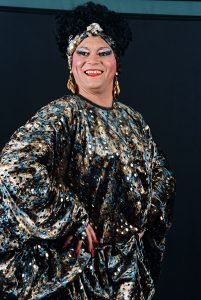
So I ended up taking photos of a tattooist and a dance teacher and a crystal healer and a Rabbi and um (…) Bobby Mandrell, or, would it be Bobby Mandrell, or Kandy Lee Barry? I can’t remember at the time, but whichever one he was back then. Um and then ended up at the Tower one night at Ladies night! I was the only man in the audience, just, you can just imagine a room full of Hull ladies! I managed to get backstage at one point and um Kandy Lee Barry and there was also a male stripper on, and (…) I got to take photos of both of them. Bobby was in his dressing room and um I just politely asked him if I could take shots. He was, he was in the middle of getting ready to go out so he just ignored me and said “yeah of course” and then let me get on with it. So, (…) I ended up taking photos of him backstage and on stage. And um the photo I liked best was the one of him backstage, I thought it was very poignant with the suitcase and half dressed half undressed, between the two worlds of Bobby. And that um that one seemed very poignant enigmatic photograph. So I took it. Then, when I, I sort of got distracted after university and ended up in the music business for years. And long story short i didnt look at the negatives from my college days for 25 years I don’t think. Maybe 30 years? a long time, 30 years, and then suddenly as is with photography you realise you’re sitting on things that become of a time important, things that seemed day to day at the time, when you’re, when you’re there. Um i realised I had some decent shots really and (…) but never did anything with them, and then (…) a friend of mine, George Norris, was becoming, was getting into his photography and becoming more and more well known as a photographer and he started taking photos of Bobby, and I said Oh, oh i’ve one you can ave, so I gave it to him and he put it on Facebook, and that’s how I met the HU3 people!
KG: Yeah, George!
MC: George yeah yeah! Um Haha
KG: So if we think of, I would really love it if you’d talk some more about the um, the male stripper, the night at the tower, what do you remember for example, the atmosphere, the feel of the building, what it looked like inside? And do you need your mince pie haha
MC: We are recording, ha, I better not! The Tower,(…) excuse me, it’s such a long time ago I don’t really have a lot of memories of The Tower, really, I knew a few of the women that were there and um (…) but obviously, it was an all woman crowd and they were drinking and it was a very rowdy atmosphere. The male stripper was a Tarzan type guy. But he took me backstage and showed me the secret – that you tie an elastic band around your willy and that is what keeps it looking super large. Hahaha. He said this is the secret of all those guys, that is how we do it! So (…) yeah it got a bit fruity when he was on,and I can’t go into too much detail! But urr it was
KG: You can!
MC: Hahaha. Well, there was quite a few women joining in, shall we say, with him (…) with him. And (…). He was the first person on before Bobby and um yeah and as a timid college student I was quite frightened to be honest. Hahaha. And argh, cos a couple of the girls that I knew that were there, you know were shocked to see me there, because I was in women’s territory and um they weren’t used to men being there, so maybe that calmed them down a bit, I don’t know whether it did or not but I just remember it being very, it was very full on sort of, sort of, evening, but yeh, um Bobby I remember coming out, he did the same sort of act is it? I am what i am? or, is that what he finishes with, he finished with “I am what I am?” in this huge winged batwing dress, it was just a phenomenal dress. I have photos of that somewhere, but um (…) but yeah, that’s about as much as I can remember, it was so long ago.
KG: And what else, were you, what year was this? When were we talking?
MC: What year? about 1987/1988.. maybe 87 or 88. i would say?
KG: What else were you photographing around the same time?
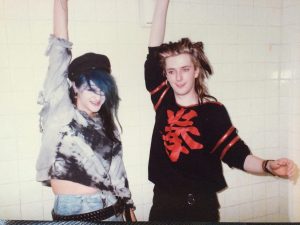
KG: What at the same time as photographing, we would, we would, get on the degree, get set a project every few months and we would have to delve into a different thing. But um one of the photo projects, we were, this was towards the end of my degree, we were just let loose to take , to find a subject and take photos of that. I was, I was sort of getting into the rave scene at that time, because I was getting into making music. So it made perfect sense to me to borrow a medium format camera and go out into the clubs where I was going anyway with my friends and start taking photos in The Welly, especially The Welly, we were at The Welly every week um, so we would go there and my friends would party and I’d be more into taking photos really, I was more into um recording what was going on sensing that it was quite a special time really, it did feel special at the time, it felt special, I don’t know why there was something in the air, I don’t know why, it just felt like we were doing something no one had ever done before, um it was quite um,a sort of magical time really, um, so yeah the photos of the raves I took, again sat dormant for 25 to 30 years, I’ve never published any of them, no one has seen them really, only the university lectures back in the late 80’s early 90’s, um so yeah.
KG: Can you talk some more maybe about the lecturers and how, what happened at college and how you were taught, you know the structure of those courses?
MC: Well the, the full time degree?
KG: All of it
MC: Well the photography degree was very much, it was called the part-time art degree with a specialist in photography, in documentary photography, and there were some really, there were the lecturers, were all really good. There was a guy called Dave Sample and Mick Faterini, who I know now died very young, and then, um sorry Mike Harper, sorry, Mick Faterini, Dave Sample and Mike Harper and um they were all photographers in their own right, they were all different types of photography they did. And um yeah we would go there once a week, to the dark rooms and develop our films and then sit and talk about them for an hour with the lecturers, and it was all very casual really. The full time degree was much more intense, that was um, serious structural analysis and semiotics and cultural studies and all this sort of thing we would get up to and um Ron Coward, who was the lecturer. He was an incredible guy who went on to Southampton to start a course called Media Subversion, or, which I think it’s still going now, something about media subversion. But he was very much into his structural analysis, cultural studies and post modernism and um all those sorts of things. So I became and expert in um semiotic, um studying people like Roland Barthe, all the french, the french philosophers of that time, sort of thing, all the structuralist philosophers and thinkers and that’s what, that was the real game changer for me, because, I’’d had no education younger, when I was younger. There was a lot of stuff he was teaching me that I might have learnt if I’d gone to do my A levels or GCSE’s. But um, so it was a big catch up for me, doing, so, um, I would avidly sit at the front and take notes for hours, three hours of these lectures. They were about three hours long and you would inevitably walk on air thinking you had found the secret of life. Hahah, and that happened every week for about a year or two. It was just phenomenal. Yeah
KG: Gorgeous.
MC: Yeah. Um (…) erh, yeah, I think, Phil Cosker was the other, he was the head, he went on to Lincolnshire i think, and he became the director in Lincolnshire at the university there.
KG: It’s a long way from HU3?
MC: Yeah, well, haha
KG: In a thinking way?
MC: In a thinking way, massive, massive. Well, to be honest, my parents were Glaswegian, they were from Govan so I’ve a big history of, I’ve still got family in Govern now, it makes Hull seem like a holiday camp. It’s very tough up there, um they live in Govern and Easter House and Gathamlock, which are really tough places, sort of places you never get out of. Um (…) so yes this, we were the posh family. And lots of my Dad’s family and my Mum’s family came down to live in Hull thinking they’d found the land of milk and glory because it was so tough up there. So, you know we were seen as the posh relatives to our family (…) um, yeah, I can’t remember, I’ve forgotten the original question now
KG:There’s a gap. There’s something about the shift for thats interesting that I’d like you to talk about, how, that you were born and raised, or you raised yourself in this area and maybe, and then to be part of that academic, deeply philosophical world, making imagery, it feels very different?
KG:Um, yeah, (…) I don’t know what I can say really,
KG: I’m wondering, how it was within the family?
MC: Well it was, the family was, um (…) we were just a typical Boulevard family really. HU3 family
KG: Talk about what that means, I don’t know what that means?
MC: The family (…). The house, the house we grew up in, in Ena Street, was small. I visited it about maybe 20 years ago, I got in there, and everything seemed so tiny. I used to sit under the stairs in Ena Street, and I thought i had a huge Den to myself but it was just,, looking back the place was just so tiny, it was just, um a two up two down, or three actually, three up three down, and, you know, ergh no such thing as central heating, you just sat, whoever got to the fire first, the gas fire first in the morning, which was usually my brother, won. And um, we were sort of latch key kids really. My mum and dad both worked. My Dad was a bus conductor, and my mother was a switchboard operator in the Royal Hotel. And we were told at a very early age, you know, I’m hungry – “well you know where the kitchen is”. And that’s how we sort of, you know? I learnt to cook very young. I spent half my time in the kitchen as a kid. Um (…) the parents were often absent and um (…) because of the long hours that they worked. My mum kept very funny hours because of her job, so did my dad actually. So they was very rarely in together and often or not, we’d be lucky if we saw one, you know, fleetingly. And um, if I wanted to see my Mum I would go into the back entrance of the station Hotel and in a cubby hole round the corner was the switchboard where she worked. Um, and I would spend hours just hanging out with her in there, even when I was supposed to be at school sometimes. Um (…), yeah. I don’t really, my sister and brother went right through school but for some reason i just, i just, the family was, I was the youngest, and the family was a bit disfunctional by the time I was a teenager.
So, yeah. You know we didn’t have it bad really compared to a lot of families in the area. You could see real, and I didn’t know it at the time, but now when I reflect you could see real signs of abuse. There would be kids turn up to school in the same clothes every day for weeks and weeks and weeks. And er, and especially going to Eastfield, what I said earlier, you saw the difference, they were much more affluent up there, a lot of the kids, but you know, there were a mix. But what we didn’t, but, cos kids can be cruel, you didn’t realise at the time but these kids turning up with dirty clothes and dirty faces whatever, they were probably just neglected children you know, that were really, having, probably having a tough time and you know we’d call them horrible names and you know ran past their houses and wouldn’t speak to them and they were probably having a really tough time on reflection. And, so, we didn’t, so we never, we didn’t. Obviously you normalise your own existence and we never thought we were hard done by or, in any way I suppose the family unit disintegrated and I decided I wasn’t going to go to school anymore, and no one stopped me, and no one seemed to care that I wasn’t going to school, so I just didn’t, um (…) In fact my Dad being a bus conductor I would sometimes jump on a bus in the opposite direction, Eastfield that way and city centre that way, and he’d be the bus conductor and he wouldn’t say a word to me, just knew I wasn’t going to school and I would get off the bus and go to the library or whatever and um (…). So I suppose, yeah, theres, you know, you saw all the sides growing up in Boulevard really, you know, and um, I feel lucky, I managed to get to university really, um, it was always inside me I think, I was just I didn’t have the right guidance to get there fast.
KG:: Talk to me a bit more then about the influence of this person, or maybe about Silhouette, or was it Spiders? Was it Silhouette where you met your girlfriend or was it a girl?
KG: Yeah I met a girl in Silhouette. We used to go to Silhouette and Spiders
KG:Tell me about Silhouette.
KG: Shilloutte was um (…). Shilloutte was basically the club, we were, what was classed as, really. Growing up in Hull, growing up in most city centres you’ve got your Meatheads or your Townies, and then you got the people who were more into fashion and music and urh culture and we were, and that’s what we were, the people who were into fashion music and culture. And if we turned up at somewhere like Tiffany’s urm (…) someone like, you know I dressed like Phil Oakley I had pointed winkle pickers and haha and a wedge, and so, and yeah i remember so yeah, So if I went into town you know, I was hot property to be picked on, you know? So we avoided there, and one of the ways we avoided there was going to Silhouette, we went to Silhouette and um and it became a real place where you felt safe, where you felt you were with like minded people, that you could look how you wanted and dress how you wanted and the music was, was just the best. The DJ, I can’t remember now, Pete! was brilliant. So we sort of shared this club together with everyone. The dance floor was downstairs and you know, there was a bar downstairs, and a bar upstairs. But the upstairs towards the door, where Molly was, was more a gay area, and then downstairs was more like everybody area and there was a pool table and what have you. And we, it was the only place where we felt safe to go out at night clubbing, there and Spiders, because, for the simple fact the Meatheads wouldn’t come in because they thought it was a gay bar, so, they, you know, they wouldn’t cross the door. So we had a safe place for clubbing on a weekend um and it was a great club anyway, the, like I said the DJ was fantastic, the PA was super loud and um you know the drinks were cheap and it attracted all, anybody that was classed as “alternative”. Whether it was your Punks, your New Romantics, um your Mods, any. They all gravitated to the old Silhouette, and um, because that’s, yeah, that was, that was where we all felt, safe, together, yeah
KG: And, so can you say more about this split between the upstairs and the downstairs? Was it never the twain shall meet ?
KG: No it was very much mixed everybody talked to everybody, yeah, it was complete mixed up, completely mixed up, but there were areas upstairs that were, sort, there was nothing officially about it, it was just the feel you got. Not your in the gay area now or the right I’m in the dance area now, or the pool area now, it was just a feeling you got. There was just a little, little, bit. The gay guys hung out more, upstairs and in the upstairs bar. We hung out downstairs where the music was really loud, and, but obviously it was all mixed up, completely mixed up, completely. But there was a certain sense of upstairs and downstairs being slightly different – If you wanted a dance you’d go downstairs and if you wanted to chat, you’d be upstairs, yeah.
KG: Can you describe what it was like inside, in terms of the feel of it, or the decor of it or?
KG:Oh my goodness!. All. The main thing I remember about Silhouette is the dance floor, the ceiling was about 6’6” and so you couldn’t really jump very high, else you’d hit your head on the ceiling and urm, it was very, very confined. It must have been you know a disaster waiting to happen, you know, it as so confined in there, and it would be packed to the hilt, you know, like sardines in there and it was yeah, obviously it was very hot, dark and sweaty and urm, yeah
KG: Exciting,
MC: Exciting, yeah, yeah, very exciting. I think, um, Thursday nights was our biggest night we would go there, that was when Pete, I can’t remember his second name, would DJ he’d put all the bands like New Order and The Clash and umm Bauhaus and stuff like that that we all liked. Urm, that was our big night was Thursdays, but we’d go there Fridays and Saturdays as well. Umm. Often what we’d do would be to go to Spiders first and then Silhouette after so you didn’t.
KG: Why?
MC: Because you didn’t want to miss anything. You had to go to both clubs in case you missed something. I think Silhouette was an older crowd than Spiders. So it was definitely an older crowd than spiders. Spiders was good umm early, early doors, but then Silhouette I think served drinks later and it just had a more mature audience – if that’s the word, laughs.. You know Spiders could be a, like a, I started to go to spiders when I was 15 and there were people, younger people, than me there when I first started going. I remember meeting a girl at spiders, umm one Saturday night, and on the Monday I saw her in her school uniform on the bus, haha, and I was absolutely shocked. I was like, no way! She was at Spiders on Saturday, she was completely different. Yeah, So Spiders was like that, it’s probably still like that now! It’s a safe space for young people. But Silhouette was a more mature crowd.
KG: Did it attract people from across town, Or I’m interested in class
MC: Silhouette?
KG: Yes, Silhouette
MC: Coughing
KG: Do feel it was people from the Aves that would come there or was it people who were alternative, it didn’t matter who they were from or what class they were from?
MC: Yeah, you’ll have to ask someone else about this but there was a very funny clause on the membership that you had to fill in, it had, something really ridiculous it was, that Ray had put on the membership, it was something really stupid that you had to admit to before you could get in. I wish I could find an old membership it had written all the rules written on the back. And um, so
KG: And the clause was what?
MC: I can’t remember, what is was, thats what I’m saying, someone must know this.
KG: In order to get in?
MC: In order to get in, you had to agree to these terms and one of the terms was a really odd thing. That um, I can’t remember was, anyway. Silhouette was full of eccentricities like that really. Umm in the new Silhouette, not the old Silhouette, they had really strange music in the toilets, like sort of ballroom music, or, you know.. There was a sense of fun and silliness there, whereas Spiders was a bit more serious and Gothy maybe, you know, a bit more immature.
KG: Did you ever take photos in there?
MC: In Silhouette? No, no, um I know people, there’s a Facebook page of all the Silhouette photos and I think I’m in one of them. But um, photographs were few and far between back then, it was very rare that people went out with a camera, um and um, yeah, I don’t think I was taking photos then, or I wasn’t thinking of taking photographs in clubs, I was just, it didn’t even occur to me I don’t think.
KG: So if you look back at that time and those photos of Ray or the Ray photographs, and that there’s things that you went on to do after this time in Hull. What do you think of those images now, what do you think of your life, if you reflect back on that part of your life given everything you’ve done?
MC: Haha, I’ve no idea, that’s a really difficult question. I can’t, um what do I think of what?
KG: Your life, With distance, both the image and the experience of doing what you did?
MC: I don’t know, I really don’t think of it, I think of it all as one. I don’t think, of it as a separate thing, it’s all part and part of parcel of who you are and what you’ve done in life, it represents just part of my life that I, for a long time, that I completely forgotten about
KG: Um tell us more about that? Why did you forget?
MC: Because it was kept in a, in a, umm, in a folder in a room, in a room, with lots of other boxes, and I didn’t even think about it until
KG: And you moved away?
MC: Tell, yeah, I moved away from Hull. I discovered them, I discovered them in London and scanned those images, in London, that I showed you earlier. But um and like most photographs you are always going to do something with your work but very few actually do. And it’s often the people that do, that get, you know, well it is the people that do something with them that um, that get the accolades. But that’s why I like, I like, what’s the publishers, the people that do the little pamphlets…? Cafe Royale. I love what Cafe Royale does. Because that’s basically thousands of students out there with portfolios, and they’ve had this genius idea , there must be thousands of people out there who didn’t quite make it in photography but have really y good portfolios from when they were at University college and they’ve made, you know, a really brilliant archive of doing these short runs that they do. So yeah. So I just forgot they existed and then at some point I thought I’m getting on now and I should get them out, it’s sad to have all these photographs and not share them with people. You’ve got to share, can’t just let them sit in a folder forever. And then, for years I’ve been meaning to do something with them but obviously life just gets in the way and then just the serendipity of George, of giving George a photograph and hahaha and sort of, that led me to the HU3 project. Yeah. So. Um.
KG: Thanks
Thank you
Recording pauses and restarts
KG: This is Kate recording for Scene but not Heard, this is second round with Murray Clarke a small addendum, whatever, an addition on the end. So talk to us about the pubs or the whatever.
MC: There were well known nights that went on, gay nights that went on, umm, in various places apart from Silhouette. I think, there was Frankies on St Georges Road and Vauxhall Tavern and um, even, there still is places. There would be, be nights, specifically gay nights, there would be nights that we would have gone to, that we went to. I never went to Frankie’s as I wasn’t around at the time, I was just doing other things then, but we would have gone because they were safe havens, they were all safe havens. And the best example was the Adelphi. When the Adelphi was first bought by Paul Jackson he put a gay night on and the gay night was fantastic because it got rid of all the rough hard drinking guys that were drinking there. The first few weeks of the Adelphi was mayhem people were throwing glasses, they just couldn’t handle this club, this old man’s club, had been taken over as a, as a music venue. I don’t know whether it was by accident or design, but the gay night really did help get rid of the people umm, that, what’s the, just the working class blokey people that were going in there and it helped to establish the Adelphi as a place to go, an alternative place to go, and that’s one place that we just to go to the gay night. My mate lived on De Grey Street and we would go there. I remember the first night him telling me there’s gay night on there and we can go there, to the Adelphi, and it will be really good. And we would love it down there.
KG:Tell us more about what it was like?
MC: It’s so long ago it’s really, it’s really vague um. The Adelphi was made up, the original Adelphi, was made up of a back room and front room. The front room was where the bands played and the back room, if you didn’t have enough money, you could walk in for free and just get, ur, a drink in there and you could still see the bands through the cubby hole you just didn’t have to pay. It was just a really nice egalitarian way of doing things. And umm, yeah and I know, I know, I spent a lot of time on De Grey Street when it first opened. I think I was about 18, um. Because we were dressed as sort of, strange, my mates, you know the men wore eye liner and stuff, sort of the new romantic look and because we were dressed like that we were always looking for somewhere, you know, safe to go, and the gay night was always, and the one at the Adelphi was the first one I went to, perhaps even before Silhouette, that was a safe haven you know, for those who didn’t fit into the towny sort of thing.
KG: So those nights, were, it was well known that those nights were, that they would be a mix?
MC: Yeah
KG: Of alternatives?
MC: Yeah, you know I’ve not been in Hull for 25years, but it was always, the gay scene was always, was always a friendly safe space for us alternative looking people to hang out with, they were just accepting of us, they were just great, yeah, yeah, saved us from getting beat up in the city centre hahaha.